

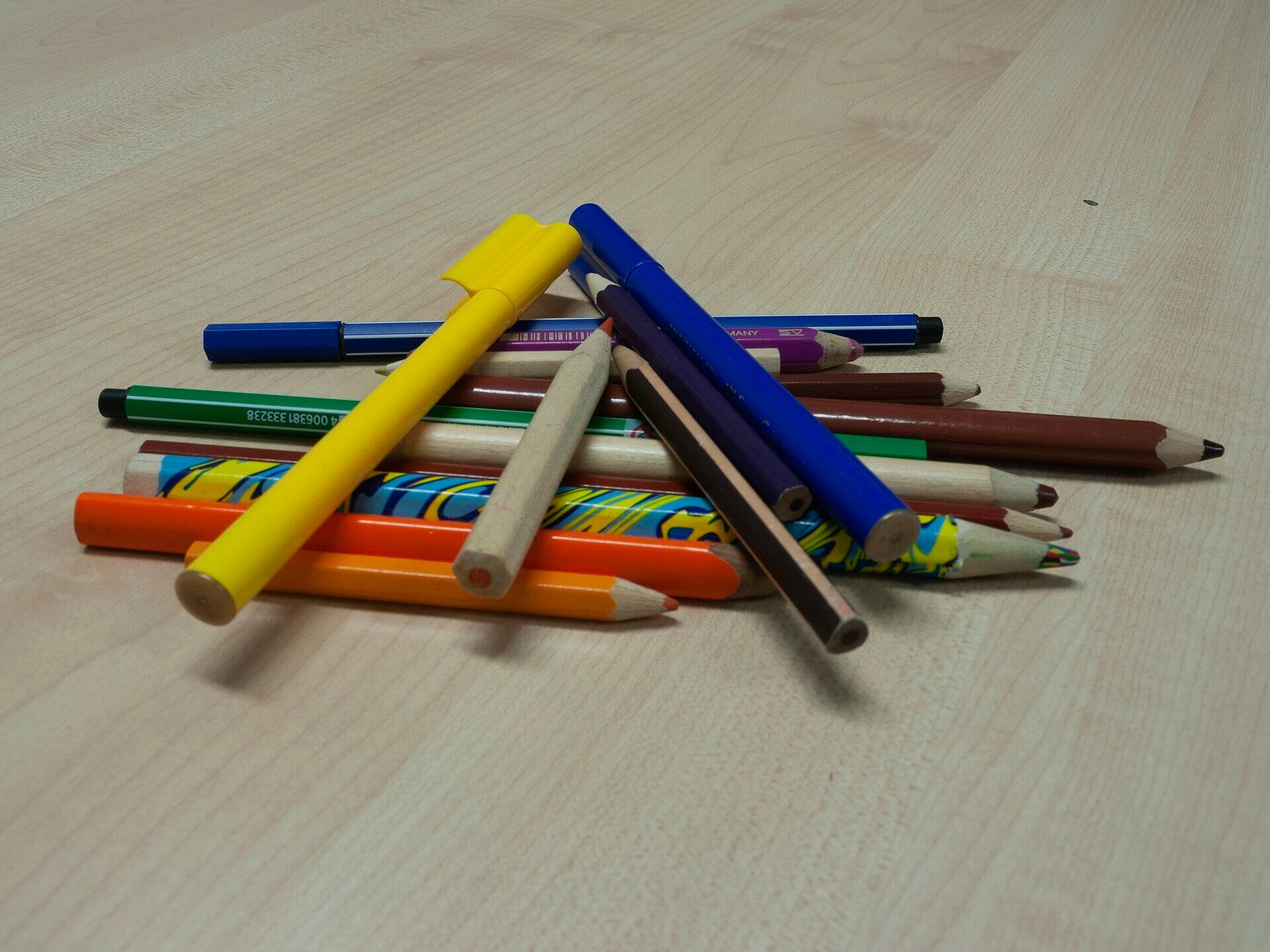
Walk into any stationery shop in India and you will find a wall of pens that all look roughly alike. Underneath the plastic and metal, though, they are very different machines. A ₹5 ballpoint, a ₹40 gel pen, a liquid-ink rollerball and a fountain pen each move ink onto paper in a different way, and that difference decides how the pen feels in your hand, how fast the ink dries, whether it smudges, whether it leaks on a flight and how long it lasts.
This guide explains every major type of pen in plain language: how it works, what it is good at, where it falls short and who should use it. It is written by Dyna Writing Instruments, a Delhi pen manufacturer that started with fountain pens in 1960 and has made ballpoint pens and refills since the late 1970s, so it also covers the practical questions buyers ask us every week: which pen suits exams, which one is best for signing documents, which types work for corporate gifting and how to choose pens in bulk.
The short answer. There are four basic ways a pen delivers ink: a rolling ball (ballpoint, gel, rollerball and hybrid pens), a split metal nib (fountain and dip pens), a porous fibre tip (fineliners, felt-tip pens, markers and brush pens) and a sealed pressurised cartridge (pressurised or “space” pens). For most everyday writing in India, a ballpoint is the most reliable and economical choice, a gel pen gives the smoothest and boldest line, a rollerball feels closest to a fountain pen without the upkeep, and a fountain pen offers the most character for people who write by hand often.
All pen types at a glance
Before going deep into each type, here is the whole family on one page. The table groups pens by the way they deliver ink, because that is what really separates one type from another. Two pens can look identical on the outside and write completely differently because one holds oil-based paste and the other holds water-based gel.
| Pen type | Ink system | Ink | Writing feel | Best for |
|---|---|---|---|---|
| Ballpoint | Rolling ball | Oil-based paste | Firm, needs light pressure | Everyday writing, forms, carbon copies, bulk and promotional use |
| Gel | Rolling ball | Water-based gel with pigment or dye | Smooth, bold, vivid | Notes, exams, journaling, colour work |
| Rollerball (liquid ink) | Rolling ball | Thin water-based liquid | Very smooth, wet line | Signatures, letters, executive use |
| Hybrid / low-viscosity | Rolling ball | Thinner oil-based ink | Smooth like gel, dries like ballpoint | Fast writers, left-handed writers, office use |
| Fountain | Split metal nib | Liquid ink from cartridge, converter or reservoir | Expressive, almost no pressure | Long-form handwriting, calligraphy, gifting |
| Fineliner / felt-tip | Porous fibre tip | Water-based or pigment ink | Precise, consistent line | Drawing, technical work, planners, colour coding |
| Marker / highlighter | Wide fibre tip | Alcohol, water or pigment ink | Broad, fast coverage | Labelling, whiteboards, study highlighting |
| Brush / calligraphy | Flexible brush or chisel tip | Water-based or pigment ink | Thick-to-thin strokes | Lettering, art, greeting cards |
| Pressurised | Sealed, gas-pressurised cartridge | Thick (thixotropic) paste | Like a ballpoint, writes at any angle | Fieldwork, travel, outdoor and cold conditions |
| Erasable | Rolling ball | Heat-sensitive gel | Like a gel pen | Students, planners, drafts |
Two more categories cut across this table. Mechanisms (cap, click, twist and slide) decide how the tip is protected, and body materials (metal, plastic, recycled plastic and plant-based materials) decide weight, feel, durability and price. A click ballpoint and a capped ballpoint are both ballpoints; a metal gel pen and a plastic gel pen are both gel pens. We cover both later in the guide.
How pens work: the four ink systems
Every pen has the same job: carry a supply of ink and release a controlled amount of it onto paper, no more and no less. The engineering challenge is that ink wants to do two contradictory things. It has to flow freely enough to leave a clean, continuous line, yet stay put when the pen is not writing so it does not leak, blot or dry out. Each type of pen solves that problem in its own way.

1. The rolling ball
Ballpoint, gel, rollerball, hybrid and most erasable pens all use a tiny metal ball, usually stainless steel or tungsten carbide, held in a socket at the tip. The ball is only a fraction of a millimetre wide. As you move the pen, the ball rotates. Its top surface picks up ink from the reservoir behind it and its bottom surface lays that ink onto the paper. When you stop writing, the ball sits in its socket like a cork in a bottle and keeps most of the ink inside.
What changes from one rolling-ball pen to another is the ink. Thick, oil-based paste gives you a ballpoint. Water-based gel gives you a gel pen. Thin, water-based liquid gives you a rollerball. Thinner oil-based ink gives you a hybrid or low-viscosity pen. The ball and socket stay broadly the same; the ink chemistry changes everything about the writing experience.
2. The split nib
Fountain pens and dip pens use a metal nib with a thin slit running down its centre. Ink travels from a reservoir through a plastic or ebonite part called the feed and down the slit by capillary action, the same force that lets a paper towel soak up water. Air moves back into the reservoir through channels in the feed to replace the ink that leaves. Because capillary action does the work, a good fountain pen needs almost no pressure; the nib simply has to touch the paper.
3. The porous fibre tip
Fineliners, felt-tip pens, sketch pens, markers, highlighters and many brush pens use a tip made of compressed fibres, foam or synthetic bristles. Ink is stored in an absorbent core inside the barrel and wicks down into the tip, again by capillary action. The size and shape of the tip set the line: a hard, fine fibre tip gives a precise line for drawing, while a wide chisel tip lays down a broad stripe of colour.
4. The pressurised cartridge
Ordinary ballpoints rely partly on gravity to keep ink at the tip, which is why they struggle when you write upside down or on a vertical wall. A pressurised pen seals the ink inside a cartridge with compressed gas behind it, so the ink is pushed towards the ball no matter which way the pen is pointing. The best-known example is the Fisher Space Pen, whose nitrogen-pressurised cartridge seals out air to prevent the ink evaporating or oxidising.
Once you understand these four systems, the rest of this guide becomes easy to follow. Every pen type below is a variation on one of them.
If you want to go further into why some pens feel smoother than others, our article The Science of Ink Flow explains how ink viscosity, ball size and tip design work together.
Ballpoint pens
The ballpoint is the most widely used pen in the world and, in India, almost certainly the first pen most people ever owned. In Indian English it is usually called a “ball pen”; in Britain it is often called a “biro”, after its best-known inventor.

How a ballpoint works
A ballpoint holds a thick, oil-based ink paste in a narrow tube called the refill. At the end of the refill sits a brass, nickel-silver or stainless-steel tip with a ball held in a precisely machined socket. The paste is too thick to drip out on its own; it only moves when the ball turns and drags a thin film of it out onto the paper. That thick ink is the key to the ballpoint’s strengths: it dries almost instantly, it resists smudging and it does not leak easily, even when the pen is carried around in a pocket or a bag.
Because the ink is thick, a ballpoint needs a little more pressure than a gel pen or rollerball, and the line is slightly paler and finer. Modern refills are far smoother than older ones, but this firm, controlled feel is still the defining trait of a ballpoint.
A brief history
The idea is older than most people think. An American named John J. Loud patented a ball-tipped pen in 1888, designed to write on rough surfaces such as leather and wood, but it was too coarse for paper and was never commercialised. The modern ballpoint came from the Hungarian journalist László Bíró, who patented his design in 1938 after noticing how quickly newspaper ink dried. His key insight was to pair the ball-and-socket tip with a thick, fast-drying ink that would not flow through a normal nib. During the Second World War, Britain’s Royal Air Force adopted the pen because, unlike fountain pens, it did not leak at high altitude. After the war, mass production turned the ballpoint from a novelty into the everyday pen it is today.
Strengths
- Quick-drying and smudge-resistant. The oil-based paste sits on top of the paper and dries almost immediately, which matters for left-handed writers and for anyone filling forms quickly.
- Long-lasting. A ballpoint refill usually writes for much longer than a gel or liquid-ink refill of the same size, because it lays down a thinner film of ink.
- Leak-resistant and travel-friendly. The thick ink rarely leaks with changes in temperature or air pressure, so ballpoints are the safest choice to carry on flights.
- Works on almost any paper. Thin, cheap, glossy, recycled or carbonless forms: ballpoint ink does not feather or bleed through.
- Presses through copies. The firm tip transfers pressure well, which is why ballpoints are still the pen of choice for carbon copies and duplicate receipt books.
- Economical at scale. Ballpoints are the most affordable pens to manufacture in large quantities, which is why they dominate promotional and institutional orders.
Limitations
- Needs more pressure. Long writing sessions can tire the hand, especially with older or cheaper refills.
- Paler line. Colours are less vivid than gel or liquid ink.
- Occasional skipping and blobs. If the tip is dirty or the ink is poor quality, a ballpoint can skip, or leave small blobs of ink (sometimes called “gooping”) at the start of a line.
- Struggles in the cold and upside down. Ordinary ballpoints can slow down in very cold weather and stop when you write against a wall or overhead.
Who should use a ballpoint
Ballpoints suit students taking long exams on thin answer sheets, office staff filling forms and registers, field workers, delivery staff, bank counters, hotels and anyone who wants a pen that simply works every time. They are also the default choice for promotional pens and bulk corporate orders, because they combine low unit cost, long writing life and a broad, printable barrel. Our plastic pen range and regular metal pens are built around ballpoint refills for exactly these reasons.
If you are comparing everyday options, our round-ups of the best ball pens in India and the classic use-and-throw “likho pheko” pen are useful companions to this section, and Ball Pen Price Range in the Market explains what drives price.
What to look for in a good ballpoint
The refill matters more than the body. Look for a tip that starts writing at once without scribbling, ink that does not leave blobs at the end of words, and a line that stays even across a full page. A slightly lower-viscosity ink (see hybrid pens below) makes a ballpoint noticeably smoother. If the pen is refillable, check that standard refills are available, so the body can keep being used after the first refill runs out.
Gel pens
Gel pens use the same rolling-ball tip as a ballpoint but replace the oil-based paste with a water-based gel. The result is a smoother, bolder, more colourful line that many students and professionals in India now prefer for everyday notes.

How a gel pen works
Gel ink is water-based, but it is thickened with special agents so that it behaves like a gel while resting in the refill and thins out into a free-flowing liquid when the ball rotates. This “shear-thinning” behaviour gives gel pens their signature feel: the ink flows generously when you write, then thickens again on the paper. Gel inks can carry pigments, which sit on the surface of the paper and give opaque, vivid colour, including white, metallic and glitter inks that show up on dark paper. Many gel refills have a visible transparent body, so you can see how much ink is left.
A brief history
Gel ink was developed in Japan by Sakura Color Products, which filed its first patent in 1982 and released the first gel pen, the Ballsign 280, in 1984. Sakura later marketed its gel pens as the Gelly Roll, and the format spread around the world through the late 1980s and 1990s. Today gel pens are made in every major market, including India, in a huge range of colours and tip sizes.
Strengths
- Very smooth. Gel pens glide with very little pressure, which reduces hand fatigue during long writing sessions.
- Bold, vivid line. The ink lays down a dark, even, highly visible line, which is why gel pens are popular for answer sheets and handwritten notes.
- Huge colour range. From standard blue and black to pastels, neons, metallics and white.
- Fine tips possible. Gel ink works well in very fine tips such as 0.38 mm and 0.5 mm, ideal for small handwriting and planners.
Limitations
- Slower drying. Gel ink takes longer to dry than ballpoint ink, so it can smudge, especially for left-handed writers or on glossy paper.
- Shorter writing life. Because a gel pen lays down more ink per word, a refill runs out sooner than a ballpoint refill.
- Can dry out if left uncapped. Retractable gel pens have improved, but a gel refill left open for long periods can dry at the tip.
- More sensitive to paper. On very thin paper some gel inks show through or feather slightly.
Who should use a gel pen
Gel pens are ideal for students who want neat, legible notes and answer scripts, for journalling and planners, for people who write a lot and want to reduce strain, and for colour-coding and creative work. If you are deciding specifically between a gel pen and a ballpoint, our detailed comparison Gel Pen vs Ball Pen walks through the differences in more depth, and The Best Pens for Exams covers exam use specifically.
For a deeper look at choosing a gel pen by tip size and ink, see Best Gel Pen in the World – How to Find It.
Rollerball (liquid ink) pens
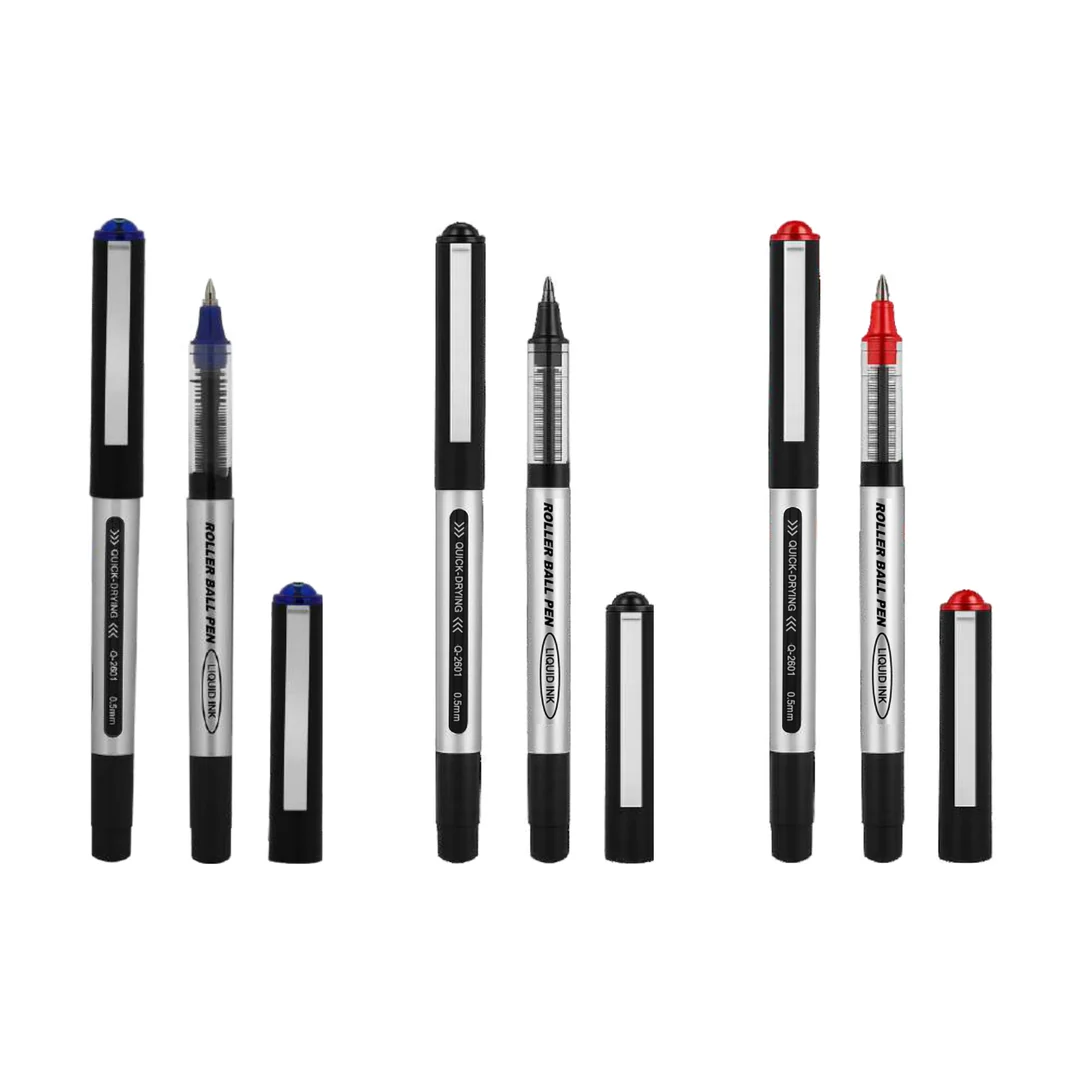
A rollerball also uses a rolling ball, but feeds it with a thin, free-flowing, water-based liquid ink, much closer to fountain pen ink than to ballpoint paste. The result is a wet, rich, very smooth line that many people describe as the closest thing to writing with a fountain pen, without the maintenance.

How a rollerball works
Because the ink is so thin, a rollerball cannot rely on thickness alone to stop leaks. Most liquid-ink rollerballs store ink either in a fibre reservoir or in a free-ink chamber with a feed system that regulates flow to the tip, similar in principle to a fountain pen feed. The ball tip then rolls this liquid onto the paper, where it soaks slightly into the fibres. That absorption gives rollerball writing its deep, saturated look.
Some manufacturers also call gel pens “gel rollerballs”, which causes confusion. In this guide, “rollerball” means a pen with liquid, low-viscosity, water-based ink; “gel” means a pen with thickened gel ink.
A brief history
The rollerball was introduced in Japan in 1963 by the company now known as Ohto, which describes it as the world’s first water-based ballpoint. It was designed to combine the convenience of a ballpoint with the smooth, wet feel of a fountain pen, and over the following decades most major pen brands added rollerballs to their ranges.
Strengths
- Exceptionally smooth. Rollerballs need almost no pressure, so they feel effortless.
- Rich, saturated line. Writing looks darker and more expressive than ballpoint writing, which is why rollerballs are popular for signatures.
- Fountain-pen feel without the upkeep. No nib to align, no bottle to fill.
Limitations
- Uses ink fast. Liquid ink flows generously, so refills empty quickly.
- Can bleed or feather. On thin or absorbent paper the ink can spread and show through.
- Must be capped. Most liquid-ink rollerballs dry out within minutes to hours if left uncapped, so they are almost always capped rather than click pens.
- Less travel-friendly. Changes in air pressure on a flight can push liquid ink out of the tip.
Who should use a rollerball
Rollerballs suit executives and professionals who sign documents frequently, people writing letters and cards, and anyone who wants a premium writing feel for meetings and desk use. Liquid-ink pens can also be very good value in promotional and corporate ranges because they feel noticeably more premium than a basic ballpoint. Our Aero Flow liquid ink pens are an example of this category.
Hybrid and low-viscosity ink pens
Hybrid pens sit between ballpoints and gel pens. They use an oil-based ink, like a ballpoint, but with a much lower viscosity, so the ink flows more freely. You will see them sold as “hybrid ink”, “low-viscosity”, “smooth ink” or “easy-flow” ballpoints.
How hybrid ink works
Traditional ballpoint paste is thick enough that the writer has to press firmly to get an even line. Hybrid inks reduce that thickness while keeping the oil base, so they glide almost as smoothly as gel but still dry quickly and resist smudging. Many modern “smooth” ballpoint refills are effectively hybrids.
Strengths
- Smooth and quick-drying. The best of both worlds for most everyday writing.
- Darker line than a standard ballpoint. Less pale and scratchy.
- Good for left-handed writers. Fast drying reduces smearing.
- Good writing life. Usually longer than gel, though shorter than a classic thick-ink ballpoint.
Limitations
- Not as vivid as gel. Colours are good but not as bold or opaque.
- Quality varies widely. A poorly balanced low-viscosity ink can blob or leak. Buy from a manufacturer that tests its refills.
Who should use a hybrid pen
Hybrids are an excellent default for office use, for fast note-takers and for left-handed writers. In corporate gifting they make a basic ballpoint feel noticeably better in the hand without moving up to a gel or rollerball price point.
Fountain pens
The fountain pen is the oldest pen design still in everyday use and, for many people, the most satisfying to write with. It is also where Dyna began: our founder, the late Mansukh Lal Mehta, started the company in 1960 making fountain pens, and some of those early Dyna pens still survive in collectors’ boxes today.

How a fountain pen works
A fountain pen has four main parts: the nib, a shaped piece of metal with a slit down the middle; the feed, which sits under the nib and controls the flow of ink; the ink reservoir, which can be a cartridge, a converter or the barrel itself; and the body and cap, which protect the nib and stop the ink drying out.
When the nib touches the paper, capillary action draws ink from the feed down the slit and onto the page. At the same time, small amounts of air bubble back through the feed into the reservoir to replace the ink that has left. This balance of ink flowing out and air flowing in is what lets a fountain pen write smoothly without flooding or running dry.
A brief history
Reservoir pens existed for centuries, but most early designs leaked or clogged. The breakthrough is usually credited to Lewis Waterman, an insurance salesman in New York who received a US patent in February 1884 for a feed that used capillary action and allowed air to enter as ink flowed out, creating a steady, even supply. Better gold nibs, hard rubber bodies and free-flowing ink turned the fountain pen into the standard writing instrument of the early twentieth century, until the ballpoint took over in the decades after the Second World War.
How fountain pens are filled
- Cartridge. A sealed plastic tube of ink that you push onto the feed. Clean, quick and ideal for beginners and travel.
- Converter. A small refillable piston or squeeze reservoir that fits in place of a cartridge, letting you draw ink from a bottle. It gives you access to many more ink colours and is cheaper per page.
- Built-in filler. Piston fillers, eyedropper pens and vacuum fillers store ink in the barrel itself. They hold much more ink but take a little more care.

Nib types and sizes
Nibs are usually graded by line width: EF (extra fine), F (fine), M (medium) and B (broad). Japanese nibs tend to write finer than European nibs of the same grade. Most everyday nibs are made of stainless steel, which is durable and affordable; gold nibs are softer and more expensive. Specialised nibs include italic and stub nibs, which make thick downstrokes and thin cross-strokes for calligraphic handwriting, and flexible nibs, which spread under pressure to vary line width.
Strengths
- Effortless writing. A good fountain pen needs almost no pressure, which makes it comfortable for long writing sessions and can improve handwriting.
- Character and expression. Line width shifts slightly with speed and angle, which gives handwriting personality.
- Endless ink choice. With a converter, you can use bottled inks in hundreds of colours.
- Long-lasting and less wasteful. A well-made fountain pen can last decades; you replace ink, not the pen.
- Prestige. Fountain pens remain a classic choice for gifting, signatures and ceremonial occasions.
Limitations
- Needs some care. Pens should be cleaned when changing ink and should not be left unused with ink inside for months.
- Paper sensitivity. Thin or absorbent paper can feather or bleed.
- Slower drying. Wet ink can smudge, especially for left-handed writers.
- Travel. Changes in cabin pressure can push ink into the cap. Keep the pen nib-up and either full or empty when flying.
Who should use a fountain pen
Fountain pens suit people who write by hand often and enjoy the process: writers, journallers, teachers, lawyers, doctors writing notes, senior executives and anyone working on their handwriting. They are also a strong choice for premium corporate gifts and milestone awards. Our Signature metal pens include fountain pens such as the Black Tie, a gloss black and gold metal fountain pen supplied in a presentation box. For guidance on handwriting specifically, see Best Pen for Good Handwriting.

Dip pens
Before reservoir pens, people wrote with dip pens: a metal nib in a simple holder, dipped into ink every few words. Dip pens are still used for calligraphy, illustration and comic inking because they accept almost any ink and offer very flexible nibs. They are not practical for everyday writing, but they are worth knowing about if you are exploring lettering.
Fineliners, felt-tip and fibre-tip pens
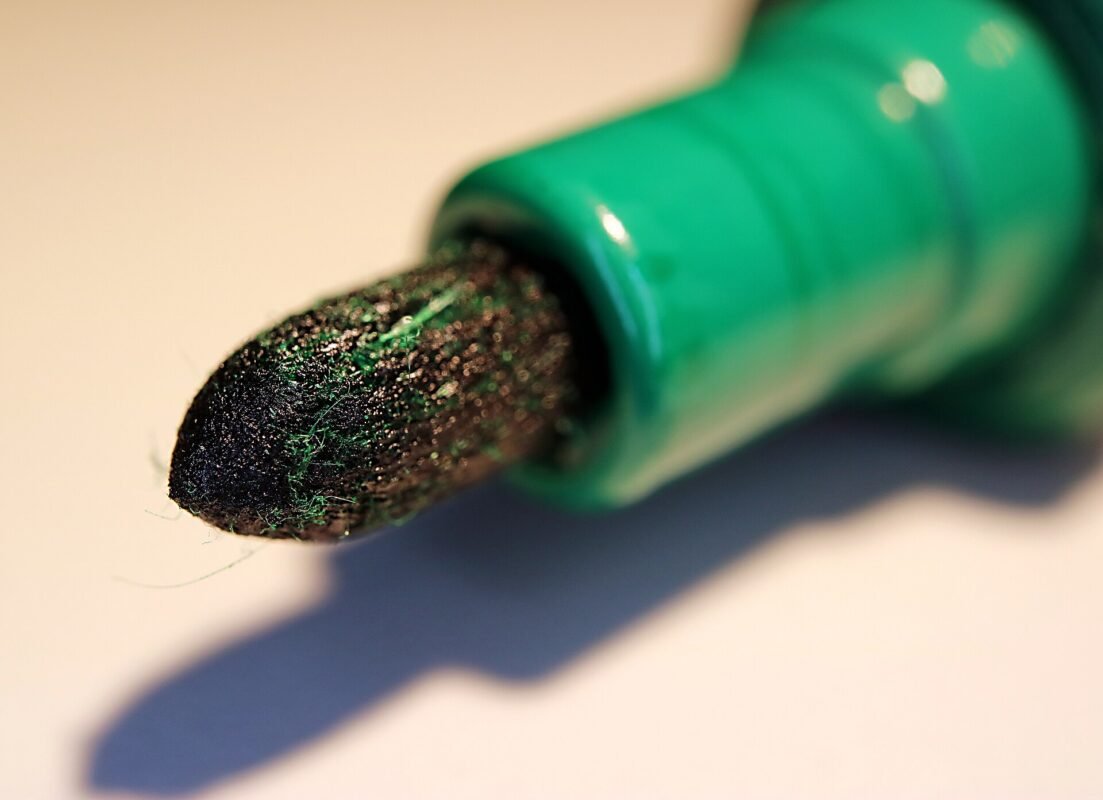
Fibre-tip pens replace the ball or nib with a tip made of compressed fibres or porous plastic. Ink stored in an absorbent core inside the barrel wicks down to the tip. In India, the colourful children’s versions are often called sketch pens; the precise, thin versions used for drawing and planners are called fineliners; and broader versions are called felt-tip pens.

A brief history
The modern fibre-tip pen was developed in Japan by Yukio Horie and Masao Miura and launched by Pentel as the Sign Pen in 1963. Its water-based ink, held in a fibre reservoir and drawn to the tip by capillary action, was a new approach, and fibre-tip pens quickly spread around the world for writing, drawing and children’s art.
Types of fibre-tip pens
- Fineliners have a hard, fine tip, often 0.1 mm to 0.8 mm, and give a precise, consistent line. Pigment-ink fineliners are popular with artists, architects and engineers because the ink is waterproof and fade-resistant once dry.
- Felt-tip and sign pens have a slightly softer, broader tip that gives a bolder line and a pleasant, slightly cushioned feel.
- Sketch pens are the colourful sets used by school children for drawing and colouring, usually with washable water-based ink.
- Technical pens, used in drafting, give an exact line width for technical drawings.
Strengths
- Consistent line width regardless of pressure, ideal for drawing and diagrams.
- No skipping. Fibre tips do not depend on a rolling ball, so they write evenly on most matte paper.
- Wide colour range and inks that range from washable to archival pigment.
Limitations
- Tips wear and fray, especially if you press hard.
- Not for carbon copies or forms that need pressure.
- Can dry out quickly if the cap is left off.
- Some inks bleed on thin paper.
Who should use fibre-tip pens
Artists, designers, architects, students making diagrams and mind maps, planner and bullet-journal users, teachers marking work and children learning to draw.
Markers and highlighters
Markers are fibre-tip pens built for coverage rather than handwriting. They have wide tips, bigger ink reservoirs and inks designed for specific surfaces.

Main types of markers
- Permanent markers use alcohol-based ink that bonds to plastic, metal, glass, cardboard and most other surfaces. They are used for labelling, packaging, cartons and industrial marking.
- Whiteboard markers (dry-erase markers) use ink formulated to sit on a non-porous board without bonding, so it wipes off cleanly.
- Highlighters use translucent, usually fluorescent, water-based ink to mark printed text without obscuring it. Gel and dry highlighters are alternatives that do not bleed through thin paper.
- Paint markers use opaque paint that works on dark, glossy and rough surfaces.
- Art and alcohol markers blend smoothly and are used for illustration and design sketching.
- CD and OHP markers are fine permanent markers for smooth plastic surfaces.
Tip shapes
Markers come with bullet tips (round, for even lines), chisel tips (angled, for both thick and thin strokes) and brush tips (flexible, for art). Many highlighters have chisel tips so you can mark a full line of text or underline neatly with the same pen.
Who needs markers
Offices, schools, warehouses, retail stores and anyone running training sessions or workshops. Highlighters remain essential for students preparing for exams. Markers are not substitutes for writing pens, but most organisations order both together.
Brush pens and calligraphy pens
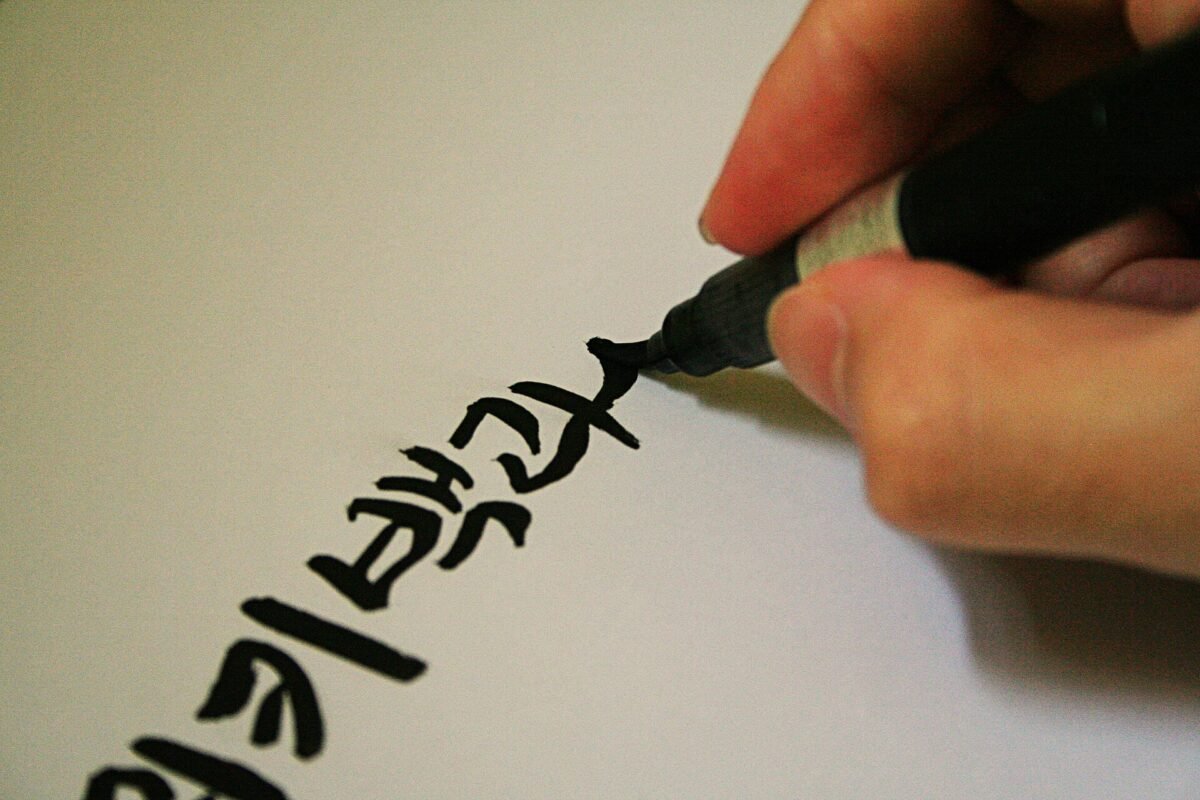
Brush pens have a flexible tip, either made of real or synthetic bristles or of a soft, pointed fibre, which bends under pressure. Press lightly and you get a thin hairline; press harder and the tip spreads into a thick stroke. This is what makes them so popular for modern hand-lettering, greeting cards, wedding stationery and art.
Types
- Bristle brush pens behave like a traditional paintbrush with built-in ink.
- Fibre-tip brush pens have a firmer, pointed tip that is easier for beginners to control.
- Water brushes have a hollow barrel you fill with water to use with watercolours.
- Chisel-tip calligraphy markers have a flat, angled tip for italic and gothic lettering.
- Calligraphy fountain pens use italic or stub nibs for broad-edged lettering.
Who should use them
Artists, illustrators, students of calligraphy, people making cards, invitations and signage, and anyone exploring lettering as a hobby. Brush pens are not suited to everyday writing on forms or registers, but they are wonderful for anything meant to look handmade.
Speciality pens
Beyond the main families, several speciality pens solve particular problems. Most are variations of the rolling-ball design with a different ink or mechanism.
Erasable pens
Erasable gel pens use a thermo-sensitive ink that turns invisible when heated. Rubbing the writing with the rubber tip on the pen creates enough friction heat to make it disappear. Pilot’s FriXion range, launched in 2006, made the format popular worldwide. Erasable pens are excellent for students, planners, crosswords and drafts, but they are not suitable for legal documents, cheques or anything that must be permanent, because heat (including a hot car or an iron) can make the writing vanish.
Pressurised pens
Pressurised ballpoints use a sealed cartridge with compressed gas behind the ink, pushing it towards the tip so the pen writes upside down, on wet or greasy paper and in cold conditions. Paul C. Fisher patented his “anti-gravity” pen in 1965; it uses a thick, thixotropic ink in a nitrogen-pressurised cartridge, and NASA later bought these pens for the Apollo programme. Pressurised pens suit field engineers, surveyors, drivers, travellers and outdoor workers.
Multi-function and multi-colour pens
Multi-pens combine two to four refills in one barrel, often blue, black and red ballpoints, sometimes with a mechanical pencil. You select a colour by sliding a switch or rotating the barrel. They are practical for teachers, accountants, editors and students who switch colours often.
Stylus pens
A stylus pen has a soft rubber or mesh tip at one end for tapping and scrolling on touchscreens, and a normal ballpoint at the other. They are popular promotional items because they are useful on both paper and phones. Note that a basic capacitive stylus is not the same as an active digital pen used for drawing on tablets.
Digital and smart pens
Smart pens use cameras or sensors to capture handwriting on special paper and send it to a phone or computer, while active styluses work directly on tablets. These are electronic devices rather than pens in the traditional sense, but they are worth mentioning because many people now combine paper notebooks with digital tools.
Security and gel-ink pens for cheques
Some gel inks contain pigments that soak into paper fibres and resist chemical washing, making it harder for fraudsters to alter writing on cheques and official documents. If you regularly write cheques, use a permanent pigment-ink pen rather than an erasable or water-soluble ink.
Highlighter pens with built-in ballpoint
Combination pens with a ballpoint at one end and a highlighter at the other are common in study kits and conference packs. They are economical for promotional use because one item covers two jobs.
Pens by mechanism: cap, click, twist and slide
The ink system tells you how a pen writes. The mechanism tells you how it opens and closes. Any of the main pen types can be made in more than one of these formats, though some combinations are more common than others.
Capped pens
The tip is protected by a removable cap that pushes or screws on. Caps seal better than retractable mechanisms, which is why fountain pens and liquid-ink rollerballs are almost always capped. Capped pens often look more classic and elegant. Their drawback is the cap itself: it can be lost or chewed, and it takes two hands to open.
Click (retractable) pens
A spring-loaded button on the top pushes the refill out and locks it, and a second press retracts it. Click pens are fast and can be used with one hand, which is why they dominate offices, hospitals, banks and promotional orders. Ballpoints and modern gel pens work well as click pens. If you want to know exactly how the mechanism works inside, our explainer Exploring the Mechanics Behind a Click Pen breaks it down step by step, and Click vs Cap Pens compares the two formats for branding.
Twist pens
You rotate one half of the barrel to extend or retract the tip. Twist mechanisms have a smooth, solid action with no button sticking out, which is why they are common on premium metal pens and executive gift pens.
Slide and push-clip pens
Some pens extend the tip by sliding a button along the barrel or by pressing the clip. These designs are less common but can be useful for multi-pens and for pens designed to be carried clipped to a pocket.
Which mechanism is best?
For speed and convenience, click pens are hard to beat. For premium feel, twist and capped designs tend to look more refined. For inks that dry quickly in air, such as liquid ink and fountain pen ink, a cap is the most reliable choice.
Pens by body material: metal, plastic and eco
The body of a pen affects how it feels, how long it lasts, how it can be branded and what it costs. The refill inside may be identical across a ₹10 plastic pen and a ₹500 metal pen; the body is often what makes the difference.
Plastic pens
Most everyday and promotional pens have bodies of moulded or extruded plastic. Plastic is light, affordable, easy to colour and easy to print on. Quality varies a lot: better plastic pens use thicker walls, accurate moulding, smooth click mechanisms and rubber grips. Extruded barrels use less material than moulded ones, as we explain in Benefits of Extruded Barrels. Plastic pens are the natural choice for events, schools, exhibitions, hotels and any large-volume giveaway. See our plastic pens.
Within our own range, Elite plastic pens offer metal-look finishes and rubber grips, while Aurora plastic pens focus on bright colours for campaigns. For high-volume giveaways, see our lightweight promotional pens and why pens work so well for mass gifting.
Metal pens
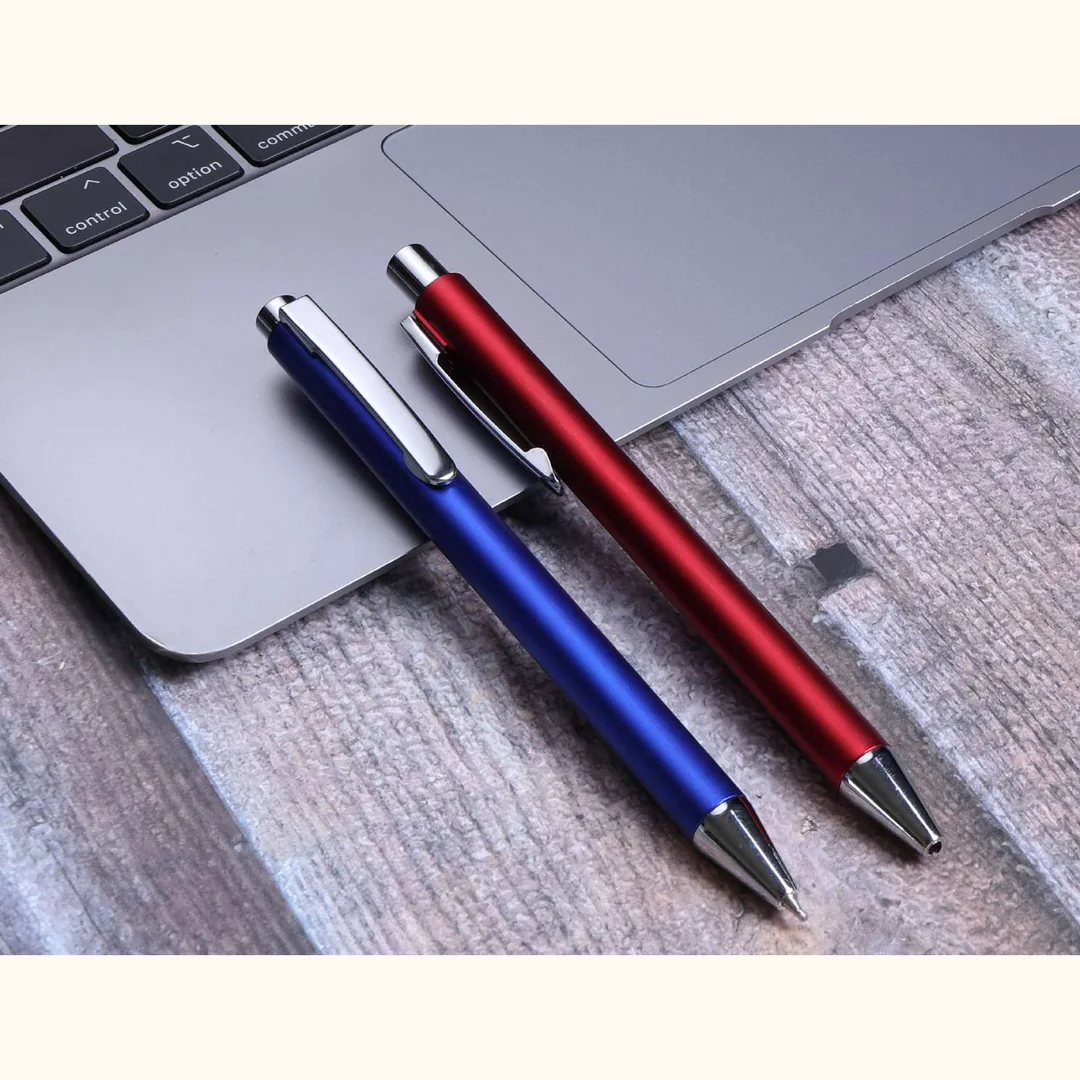
Metal pens use aluminium, brass or stainless-steel barrels, often finished with lacquer, anodising, chrome or matte coatings. They feel heavier and more balanced in the hand, last much longer and take laser engraving beautifully, because the laser removes the coating to reveal bright metal beneath. Metal pens are the standard for executive gifts, client gifts, awards and corporate kits. See our premium metal pens and regular metal pens.

Eco-friendly pens
Eco pens reduce environmental impact by using recycled plastic, paper or cardboard barrels, bamboo, wheat-straw composites or other plant-based materials, and by being refillable. They are increasingly requested by companies with sustainability goals. A refillable pen with a durable body often has a smaller footprint than a disposable pen made from “green” material, so it is worth considering both the material and the lifespan. See our eco-friendly pens and our comparison Eco Klick vs Eco Polo.
Wood, resin and luxury materials
At the top end, pens are made in precious resins, hardwoods, carbon fibre, lacquered brass and even precious metals. These are usually fountain pens or rollerballs bought as personal treasures or significant gifts.
Tip sizes and ink colours explained
Tip sizes
For ballpoint, gel and rollerball pens, the number on the barrel (0.38, 0.5, 0.7, 1.0) usually refers to the diameter of the ball in millimetres. The line on paper is generally a little narrower than this number for ballpoints and closer to it for gel and liquid ink, because those inks spread slightly.
- 0.38–0.5 mm (extra fine to fine): neat, small handwriting, planners, forms with small boxes and annotations.
- 0.6–0.7 mm (medium): the most common everyday size; a good balance of smoothness and neatness.
- 1.0 mm and above (broad): bold, very smooth writing and signatures; uses more ink.
Finer tips feel scratchier because a smaller ball has less contact with the paper. Broader tips feel smoother but lay down more ink and dry more slowly. For fountain pens, nib grades (EF, F, M, B) serve the same purpose.
Ink colours
- Blue is the standard in Indian schools, examinations and many offices, and makes it easy to tell an original signature from a black photocopy.
- Black is standard for formal documents, legal paperwork and many international forms, and photocopies and scans clearly.
- Red is used for correction, marking and highlighting.
- Green is traditionally reserved in some Indian government offices and institutions for senior officials, so check your organisation’s rules before using it on official documents.
- Coloured, metallic and pastel inks are for creative work, journals and greeting cards.
Always check the specific requirements of your exam board, bank or office. Some examinations accept only blue or black ink, and some documents require a particular colour.
Dye versus pigment ink
Dye-based inks dissolve in their carrier and give bright, saturated colour, but can fade in sunlight and may run if wet. Pigment-based inks suspend tiny solid particles that sit on or bind to the paper; they are usually more water-resistant and fade-resistant, which is why they are preferred for archival and legal use.
Side-by-side comparison table
Here is how the most common writing pens compare on the points buyers ask about most often. Ratings are general guides; individual pens and refills vary.
| Feature | Ballpoint | Hybrid | Gel | Rollerball | Fountain | Fineliner |
|---|---|---|---|---|---|---|
| Smoothness | Good | Very good | Excellent | Excellent | Excellent | Very good |
| Drying speed | Very fast | Fast | Moderate | Slow | Slow | Fast to moderate |
| Smudge resistance | Excellent | Very good | Fair | Fair | Fair | Good |
| Line boldness | Light to medium | Medium | Bold | Bold | Varies with nib | Consistent |
| Writing life per refill | Longest | Long | Moderate | Short | Depends on ink capacity | Moderate |
| Leak resistance on flights | Excellent | Very good | Good | Fair | Needs care | Good |
| Works on thin paper | Excellent | Very good | Good | Fair | Fair | Good |
| Carbon copies | Yes | Yes | Limited | No | No | No |
| Maintenance | None | None | None | Keep capped | Regular cleaning | Keep capped |
| Typical cost per pen | Lowest | Low | Low to medium | Medium | Medium to high | Low to medium |
| Best for | Everyday, forms, bulk | Office, fast writers | Notes, exams, colour | Signatures, letters | Handwriting, gifting | Drawing, planners |
For a closer look at the three rolling-ball pens that most people choose between, see our separate guide Ballpoint vs Gel vs Rollerball: Which Is Best for You?
How to choose the right type of pen
There is no single best pen, only the best pen for a particular job. Start with how and where the pen will be used, then choose the ink system, then the tip size, then the body.
For students and exams
Long exams reward a pen that is smooth, consistent and does not run out half-way. Many students prefer a gel pen for its bold, legible line, while others prefer a smooth ballpoint or hybrid because it dries instantly and lasts longer on thin answer sheets. Whatever you choose, carry at least two identical pens, use the colour your board requires, and practise with the pen before the exam rather than opening a new model on the day. Our guide The Best Pens for Exams covers this in detail.
For office work and forms
A click ballpoint or hybrid pen in blue or black is the most practical everyday office pen. It writes on any paper, dries instantly, presses through duplicate forms and can be used one-handed while holding a phone. Keep a red pen for corrections and a highlighter for documents.
For signing documents
For contracts, cheques and official papers, you want a line that is clearly visible, hard to alter and permanent. A good ballpoint or pigment-based gel pen is a safe choice. Many professionals use a rollerball or fountain pen for a more distinctive signature. Avoid erasable pens and washable inks on anything that must be permanent.
For left-handed writers
Left-handed writers often drag their hand through fresh ink. Quick-drying ballpoints and hybrid pens are the safest choice. Fine-tip gel pens with fast-drying inks are a good second option. Wet inks such as rollerball and broad fountain pen nibs are the most likely to smudge.
For people who write a lot
If you write for hours, reduce the pressure your hand has to apply. Gel, rollerball and fountain pens all need very little pressure. A slightly thicker barrel and a rubber or textured grip can also reduce fatigue. A pen with a little weight, such as a metal pen, lets the pen’s own mass do some of the work.
For journalling and planners
Fine gel pens (0.38–0.5 mm) and fineliners give neat lines in small spaces and come in many colours for colour-coding. Fountain pens are wonderful for long journal entries if the paper is good quality.
For drawing, design and technical work
Pigment fineliners in several widths, plus brush pens for shading and lettering, cover most needs. Engineers and architects may prefer technical pens with exact line widths.
For travel and fieldwork
A ballpoint is the safest pen on a flight. For outdoor work, cold weather or writing on wet paper, a pressurised ballpoint is worth the extra cost. Avoid carrying liquid-ink rollerballs and part-filled fountain pens in checked luggage.
For gifting
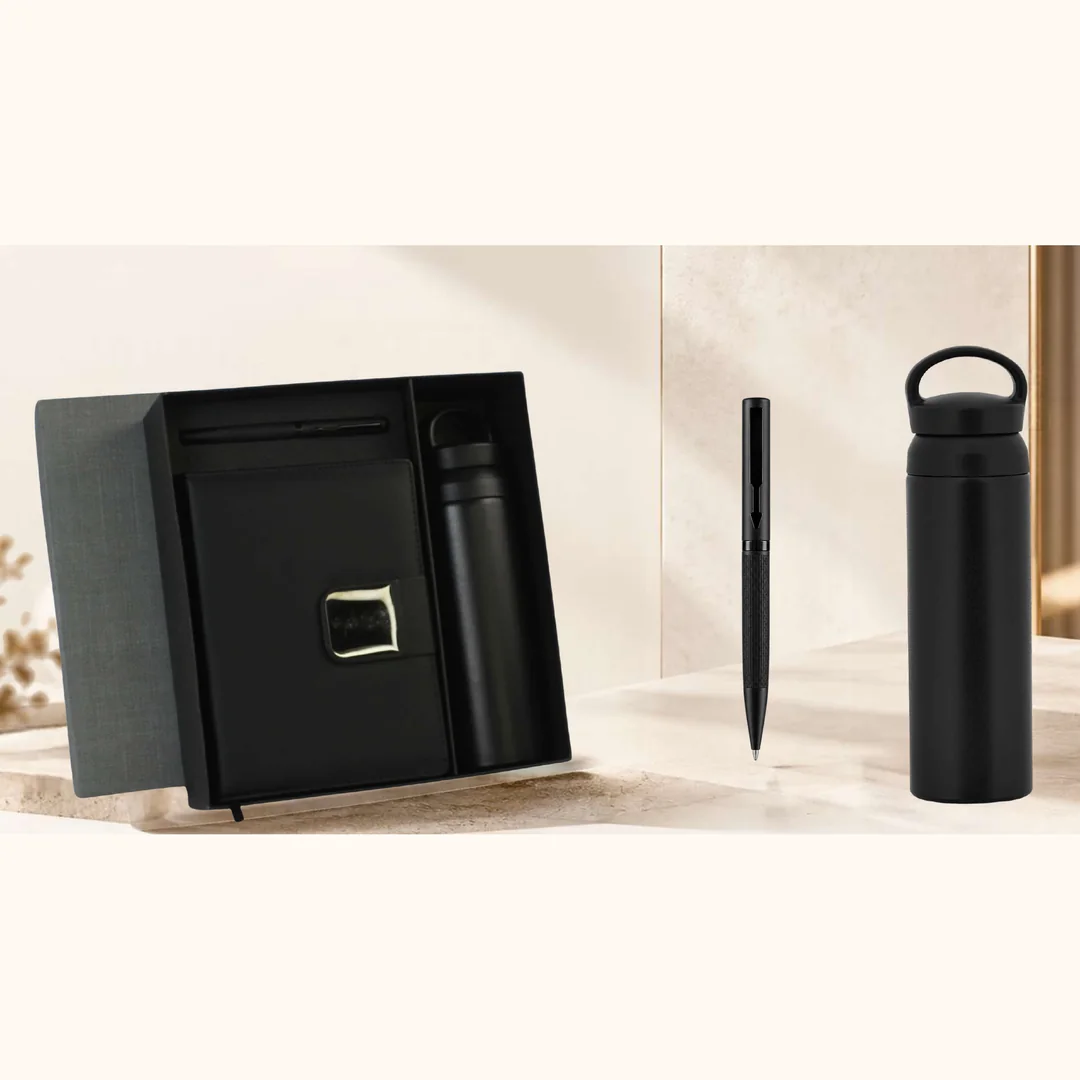
For personal gifts and senior colleagues, a metal rollerball or fountain pen in a presentation box feels special. For clients and teams, a premium metal ballpoint with laser engraving balances quality, longevity and budget. Gift sets that pair a pen with a notebook or diary are popular for festivals, onboarding and annual events. Our gift sets and the guide Corporate Gifting Pens go into this in detail.
For teachers, mentors and school events, our guide to ball pens to gift your teacher has ideas at every budget, and Best Personalised Gifts for Employee Recognition covers workplace occasions.
For events, conferences and promotions
For large volumes, plastic click ballpoints with a printed logo give the best cost per impression. They are cheap enough to hand out freely, last a long time and get used every day, which keeps the brand name visible. For VIP delegates, step up to a metal pen.
Our article How Branded Pens for Events Create Long-Term Brand Recall explains why pens outlast most other event giveaways.
A quick decision checklist
- Where will it be used? Desk, pocket, field, exam hall, flight.
- How much will it be used? Occasional signatures or hours of writing each day.
- What paper? Thin forms, good notebooks, glossy brochures, duplicate books.
- Who is writing? Left- or right-handed, light or heavy pressure, large or small handwriting.
- What colour and permanence? Exam rules, legal documents, colour-coding.
- What budget, and is it refillable?
Which type of pen suits which profession?
Different jobs put different demands on a pen. Here is how the main pen types match the people we supply most often.
Doctors and hospital staff
Doctors write prescriptions, case notes and forms all day, often standing up and in a hurry. A click ballpoint or hybrid pen is the practical choice: one-handed, quick-drying and dependable on every kind of paper. A clip that holds firmly in a coat pocket matters more than looks. Hospitals ordering in bulk usually prefer a standard refill so pens can be kept in service rather than thrown away.
Teachers and lecturers
Teachers need a reliable everyday pen plus a red ballpoint or gel pen for marking, and often a set of whiteboard markers. Multi-colour pens save switching between pens while checking notebooks. For writing on the board, chisel-tip markers give clearer letters from the back of the classroom.
Lawyers, chartered accountants and bankers
These professions sign and annotate documents constantly, so permanence and clarity matter. A quality ballpoint or pigment-based gel pen in blue or black is standard, often with a metal body that looks professional in meetings. Many senior professionals keep a fountain pen or rollerball for signatures and important letters. Erasable pens should never be used on legal or financial documents.
Students
Students benefit from a small, well-chosen set: two identical exam pens (gel or smooth ballpoint), a red pen, a highlighter or two, and a few fineliners or coloured gel pens for diagrams and revision notes. Erasable pens are handy for rough work but not for answer sheets.
Architects, engineers and designers
Pigment fineliners in several widths, a technical pen for drawings, and alcohol markers for rendering cover most design work. A pressurised pen is useful on site, where you may need to write on wet or vertical surfaces.
Writers, journallers and calligraphers
People who write for pleasure tend to gravitate towards fountain pens, rollerballs and fine gel pens, along with brush pens and italic nibs for lettering. Paper quality matters as much as the pen; a good notebook prevents feathering and bleed-through.
Hotels, restaurants and hospitality
Hotels need pens at reception, in rooms, in meeting halls and at restaurant counters. Branded click ballpoints are the standard because guests use them briefly and often take them home, which turns every pen into a small advertisement. Meeting rooms and premium suites may warrant a metal pen or a pen-and-notepad set.
Retail, logistics and field staff
Counter staff, delivery teams, warehouse workers and sales representatives need pens that survive rough handling. Click ballpoints with sturdy clips and permanent markers for labelling cartons are the essentials. Field staff working outdoors may benefit from pressurised pens.
Corporate leadership
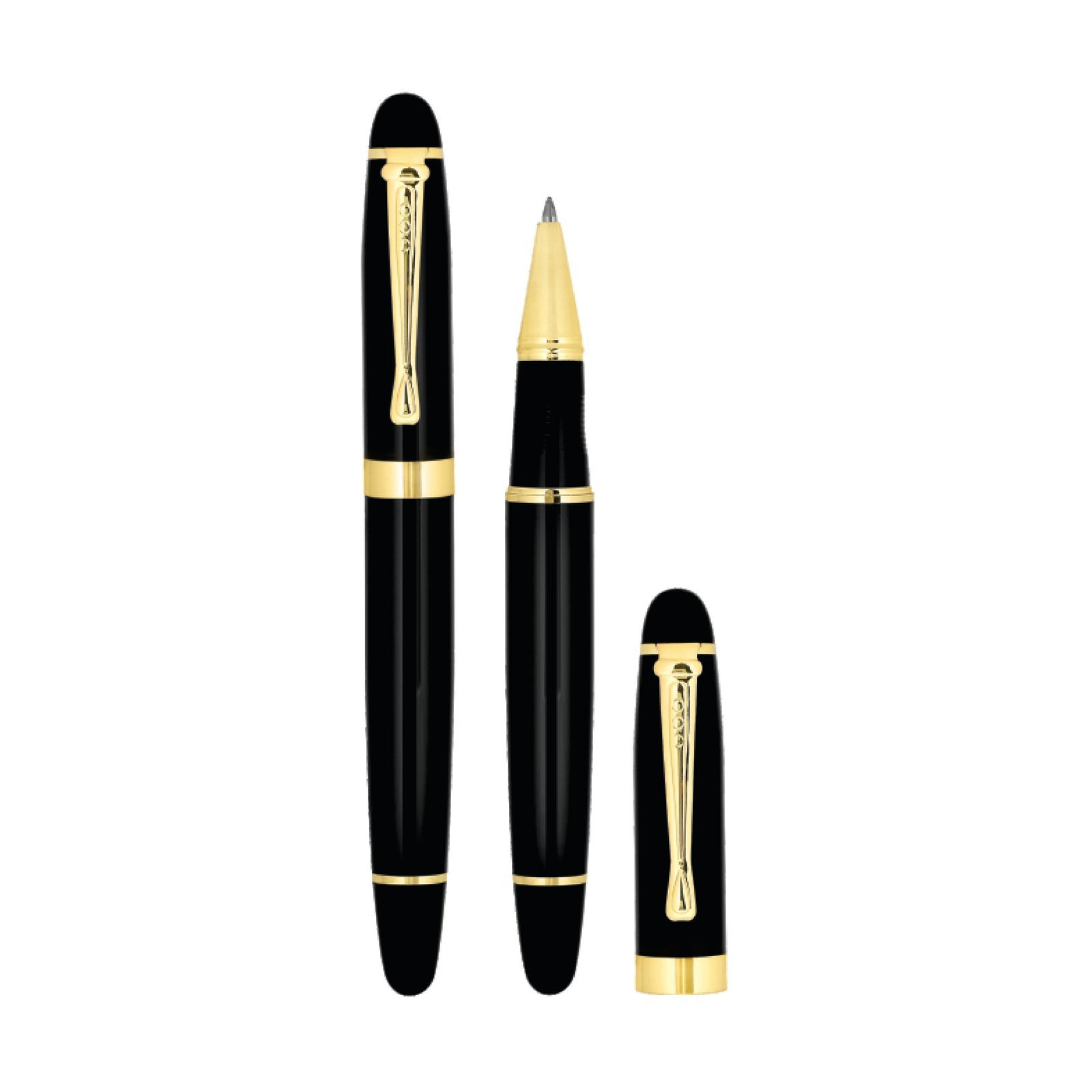
Senior leaders sign contracts, letters and approvals, and their pen is often seen by clients and partners. A premium metal pen such as a weighty ballpoint, rollerball or fountain pen, engraved with a name or logo, suits this role. Many companies present such pens on promotions, anniversaries and retirements.
A note on refills
Most ballpoint, gel and rollerball pens are refillable, and the refill is where the writing quality really lives. Refills differ in length, diameter, tip design and ink, and a refill made for one pen will not always fit another. When choosing pens that will be used for a long time, it helps to pick a design that takes a widely available refill, so users can replace the ink rather than the whole pen. Dyna has manufactured its own refills since the late 1970s, which is why we pay particular attention to refill compatibility when we recommend pens for bulk and corporate use.
A few practical refill tips:
- Keep one old refill when you buy a new pen, so you can match length and tip shape later.
- Ballpoint, gel and liquid-ink refills are generally not interchangeable, even if they look similar, because their tips and ink feeds are designed differently.
- Store spare refills tip-down or flat in a cool place, away from sunlight.
- For fountain pens, check whether your pen takes short international cartridges, long cartridges or a brand-specific design before buying ink.
Quality standards for pens
Pens may look simple, but there are international standards that define minimum quality. The International Organization for Standardization publishes separate standards for ballpoint pens and refills (ISO 12757), rollerball pens and refills (ISO 14145) and gel ink ball pens and refills (ISO 27668), with additional parts covering “documentary use” pens, whose writing is intended to be permanent enough for official records. There is also a shared vocabulary standard for ball point and roller ball pens (ISO 12756).
For buyers, the practical takeaway is simple: a reputable manufacturer tests writing length, line consistency, start-up, ink drying time, resistance to light and water, and the strength of clips and mechanisms. When ordering in bulk, ask how refills are tested and request samples before confirming a large order.
Looking after your pens
Ballpoint, gel and hybrid pens
- Store pens tip-down or horizontally, with caps on or tips retracted.
- If a ballpoint will not start, scribble gently on scrap paper or warm the tip slightly between your fingers.
- Keep pens away from direct sunlight and very hot cars, which can thin the ink and cause leaks.
- Replace the refill rather than the pen when the body is in good condition.
Rollerball and fibre-tip pens
- Always replace the cap immediately after use.
- Do not press hard on fibre tips; it flattens and frays them.
- Store markers horizontally so ink stays evenly spread between both ends.
Fountain pens
- Flush the pen with clean water every few weeks and whenever you change ink.
- Do not leave ink in a pen you will not use for a month or more.
- Use fountain pen ink only; drawing inks and calligraphy inks can clog the feed.
- When flying, travel with the pen full or empty, and keep it nib-up.
- Never lend a fountain pen with a fine nib to someone who presses hard; nibs adapt to their owner’s angle and can be bent.
For an idea of how long a well-made pen can last with sensible care, see How Long Does a Dyna Pen Last?
Common pen problems and how to fix them
| Problem | Usual cause | What to do |
|---|---|---|
| Ballpoint will not start | Dried ink or dirt at the tip; air in the refill | Scribble in small circles on scrap paper; warm the tip gently in your hand; check the refill still has ink |
| Blobs of ink at the start or end of lines | Ink collecting around the ball, often with thick or low-quality paste | Wipe the tip with tissue; switch to a smoother or hybrid refill |
| Skipping lines | Greasy or glossy paper; worn tip; writing at a steep angle | Try plain paper; hold the pen more upright; replace the refill |
| Gel pen fades mid-word | Air bubble or ink separated from the tip | Tap the pen tip-down; store gel pens tip-down |
| Writing smudges | Slow-drying ink; left-handed writing; glossy paper | Switch to a ballpoint or hybrid; use a finer tip; let ink dry before closing notebooks |
| Ink bleeds through the page | Wet ink on thin or absorbent paper | Use a finer tip, a ballpoint, or better-quality paper |
| Pen leaked in a bag or on a flight | Heat or air pressure changes pushing liquid ink out | Carry ballpoints when travelling; keep rollerballs and fountain pens capped and nib-up |
| Fountain pen writes dry or hard-starts | Dried ink in the feed; pen unused for a long time | Flush with water; refill with fresh ink; store capped |
| Fountain pen floods or drips | Pen warming in the hand with little ink left; damaged feed; wrong ink | Keep the reservoir reasonably full; use proper fountain pen ink; have the nib checked |
| Felt-tip or marker is dry | Cap left off; tip pushed in | Replace the cap firmly; store horizontally; replace if the tip is damaged |
| Click mechanism sticks | Dirt or a worn spring | Remove and reseat the refill; replace the spring or pen if damaged |
Choosing pen types for business and bulk orders
Companies, schools, hotels, hospitals, banks and event organisers buy pens in very different ways from individual shoppers. A pen that is perfect for one person’s journal may be the wrong choice for 5,000 conference delegates. These are the questions we work through with business buyers at Dyna.
1. What is the pen for?
- Daily use by staff (front desks, branches, wards, classrooms): reliable click ballpoints or hybrids with standard refills.
- Brand visibility at events and exhibitions: light, colourful plastic ballpoints with a clear printed logo, ordered in volume.
- Client and partner gifts: metal ballpoints, rollerballs or gift sets with laser engraving.
- Awards, milestones and senior gifting: premium metal pens or fountain pens in presentation boxes.
- Sustainability-led campaigns: eco pens with recycled or plant-based bodies, ideally refillable.
2. Which ink system?
For most business volumes, ballpoint or hybrid refills are the most practical: they last longest, travel well and suit every kind of paper. Liquid-ink and gel pens are good upgrades when the writing experience itself is part of the impression you want to create. Fountain pens are best kept for personal, high-value gifts.
3. Which body and mechanism?
Click pens are the most convenient for daily use. Twist and capped metal pens feel more premium. Plastic keeps cost per piece low; metal adds weight, durability and a better surface for engraving.

4. How will it be branded?
Different pen bodies suit different branding methods:
- Pad printing and screen printing work well on plastic barrels and clips and are economical for large runs.
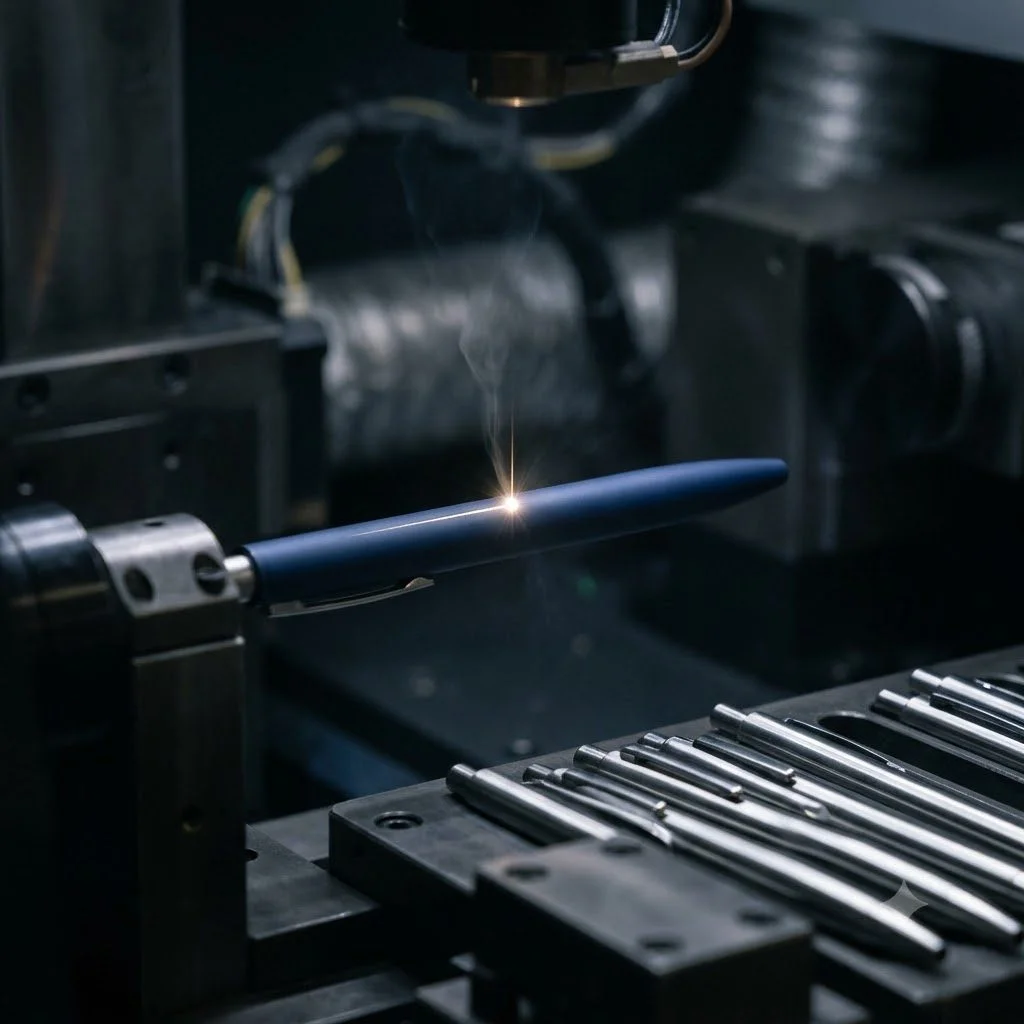
- Laser engraving gives a permanent, elegant mark on coated metal pens and is ideal for names and logos on executive gifts.
- UV printing allows full-colour logos on suitable surfaces.
At Dyna, branding is done in-house and we recommend the method that suits the pen and your artwork. Our guide How to Design Your Own Branded Pen explains the process from artwork to delivery.
Pens are often ordered alongside other branded items. Many of our clients combine them with branded diaries, notebooks, metal keychains, visiting card holders and desk organisers to build complete welcome kits. For more on how custom pens strengthen brand identity, see our branding guide.
5. Refills, quality and samples
Ask whether the pen takes a standard refill, how the refills are tested and what writing length to expect. Always request samples before confirming a large order, write with them on the paper your team actually uses, and check clips, mechanisms and print quality. Our article What to Look for in a Bulk Pen Supplier lists the questions worth asking.
6. Lead times and planning
Large orders with custom branding need time for artwork approval, sampling, production and delivery. For festivals, financial year-end, conferences and onboarding drives, start planning several weeks ahead so you are not forced to compromise on the pen or the branding.
Distributors and resellers should also read Logistics and Lead Times and Common Myths About Bulk Pen Orders. If you would like to stock DYNA pens, see How to Become a Dyna Pen Distributor or Dealer; for buyers outside India, our export page and country import guides explain how we ship worldwide.
Need help choosing? Dyna has manufactured writing instruments in Delhi since 1960, across plastic pens, metal pens, eco pens, fountain pens, refills, diaries, notebooks and gift sets. Tell us the occasion, quantity and budget and we will suggest suitable pen types and branding options. Request a quote or explore our corporate gifting range.
A short timeline of the modern pen
- Ancient times: reed pens, brushes and quills dipped in ink are used across Egypt, China, India and Europe for thousands of years.
- 1884: Lewis Waterman receives a US patent for a fountain pen feed that uses capillary action for a steady flow of ink, a key step towards the reliable fountain pen.
- 1888: John J. Loud patents a ball-tipped marking pen for rough surfaces such as leather. It is not commercialised.
- 1938: László Bíró patents the modern ballpoint, pairing a ball tip with fast-drying, thick ink.
- 1940s: Ballpoints are adopted by Britain’s Royal Air Force because they do not leak at altitude, and mass production follows after the war.
- 1960: Dyna Writing Instruments is founded in Delhi, beginning with fountain pens.
- 1963: The fibre-tip Sign Pen is launched in Japan, and Ohto introduces the water-based rollerball.
- 1965: Paul C. Fisher patents the pressurised “anti-gravity” ballpoint, later used on Apollo missions.
- Late 1970s: Dyna moves into ballpoint pens and refill manufacturing, building its own production systems.
- 1984: Sakura releases the first gel pen in Japan.
- 2006: Pilot launches FriXion erasable gel pens in Europe, popularising thermo-sensitive erasable ink.
- Today: low-viscosity hybrid inks, recycled and plant-based bodies, and pens that combine paper with digital devices continue to evolve the category.
For the Indian side of this story, read The Evolution of Pen Manufacturing in India.
Pen glossary: terms worth knowing
- Barrel
- The main body of the pen that holds the refill or ink reservoir.
- Cartridge
- A sealed, disposable tube of ink for a fountain pen.
- Converter
- A refillable reservoir that replaces a cartridge so a fountain pen can be filled from a bottle.
- Feed
- The part under a fountain pen nib that regulates the flow of ink and lets air back into the reservoir.
- Feathering
- When ink spreads along paper fibres, giving lines fuzzy edges.
- Bleed-through
- When ink soaks through to the other side of the page.
- Ghosting
- When writing is visible from the back of the page without actually soaking through.
- Hard start
- When a pen does not write immediately on the first stroke.
- Skipping
- Gaps in a line where the ink fails to reach the paper.
- Viscosity
- How thick an ink is. High-viscosity ink (ballpoint paste) flows slowly; low-viscosity ink (rollerball, hybrid) flows freely.
- Pigment ink
- Ink with tiny solid colour particles, usually more water- and fade-resistant.
- Dye ink
- Ink in which colour is dissolved, usually brighter but less permanent.
- Tungsten carbide ball
- A very hard ball material used in quality refills for long, consistent writing.
- Refill
- The replaceable ink tube and tip inside a ballpoint, gel or rollerball pen.
- Clip
- The metal or plastic arm that holds the pen to a pocket, notebook or diary, and a common branding position on promotional pens.
- Section or grip
- The part of the pen you hold, often shaped, textured or rubberised for comfort.
- Nib grade
- The width of a fountain pen nib, from extra fine (EF) to broad (B).
- Italic or stub nib
- A fountain pen nib with a flat edge that makes thick and thin strokes.
- Documentary ink
- Ink intended to remain legible on official records, resisting light, water and tampering.
- Laser engraving
- A branding method that uses a laser to mark a logo or name permanently into a pen’s surface, most often on coated metal pens.
- Pad printing
- A printing method that transfers ink from an etched plate to a curved surface such as a pen barrel, using a soft silicone pad.
Frequently asked questions
What are the main types of pens?
The main types are ballpoint, gel, rollerball, hybrid (low-viscosity ballpoint), fountain, fineliner and felt-tip, marker and highlighter, and brush pens. Speciality types include erasable, pressurised, multi-function, stylus and smart pens.
What is the difference between a ballpoint, gel and rollerball pen?
All three use a rolling ball at the tip. The difference is the ink: a ballpoint uses thick, oil-based paste that dries fast and lasts long; a gel pen uses water-based gel for a bold, smooth line; a rollerball uses thin, liquid, water-based ink for the smoothest, wettest line, but it dries more slowly and needs a cap.
Which type of pen is best for everyday writing?
For most people, a smooth ballpoint or hybrid pen is the best everyday choice. It works on any paper, dries instantly, lasts long and is easy to carry. If you prefer a bolder line and do not mind slightly slower drying, choose a gel pen.
Which pen is best for exams in India?
Both gel pens and smooth ballpoints are popular for exams. Gel pens give darker, clearer writing; ballpoints dry instantly and last longer on thin answer sheets. Use the ink colour your exam board requires, carry at least two identical pens and practise with them first.
Which pen is best for signing documents?
Use a permanent ink that is hard to alter, in the colour your organisation requires. A good ballpoint or a pigment-based gel pen is a safe choice; many people prefer a rollerball or fountain pen for a more distinctive signature. Never use an erasable pen for signatures.
Which pen is best for left-handed people?
Quick-drying pens are best because they reduce smudging: ballpoints and hybrid low-viscosity pens first, then fine gel pens with fast-drying ink. Wet inks such as liquid rollerballs and broad fountain pen nibs are more likely to smear.
Is a fountain pen better than a ballpoint?
Neither is better in every way. A fountain pen needs almost no pressure, has more character and can improve handwriting, but it needs care and good paper. A ballpoint is more practical, cheaper, travels better and works on any paper. Many people use both.
What does 0.5 mm or 0.7 mm mean on a pen?
It is usually the diameter of the ball at the tip. Smaller numbers give finer lines and neater small handwriting; larger numbers give bolder, smoother lines but use ink faster.
Why does my pen skip or stop writing?
Common reasons are a dirty tip, dried ink at the tip, writing on greasy or glossy paper, very cold conditions, or holding a non-pressurised ballpoint upside down. Scribble gently on scrap paper, clean the tip and store pens with tips protected.
Which pens are safe to carry on a flight?
Ballpoints are the safest. Gel and hybrid pens are generally fine. Liquid-ink rollerballs and fountain pens can leak because of cabin pressure changes; carry them nib-up and keep fountain pens either full or empty.
What is the most eco-friendly type of pen?
A durable, refillable pen is usually the most sustainable, because the body is reused for years. Pens with recycled or plant-based bodies reduce material impact further. A fountain pen used with bottled ink is among the least wasteful options for heavy writers.
What is a hybrid ink pen?
A hybrid pen uses an oil-based ink with lower viscosity than a traditional ballpoint. It writes almost as smoothly as a gel pen while drying almost as fast as a ballpoint.
What type of pen is best for corporate gifts?
For clients and senior colleagues, a metal ballpoint, rollerball or fountain pen with laser engraving, ideally in a gift box. For large teams and events, branded plastic or eco ballpoints offer the best value and visibility.
Do expensive pens write better than cheap pens?
Not always. The writing quality comes mostly from the refill and ink, while the price often reflects the body material, finish, weight and brand. A well-made affordable pen with a good refill can write as smoothly as a costly one. Expensive pens tend to last longer, feel better in the hand and make better gifts.
What is the difference between a felt-tip pen and a fineliner?
Both use fibre tips. A fineliner has a hard, very fine tip for precise, consistent lines in drawing and planners; a felt-tip pen has a softer, broader tip for bolder writing and colouring.
The DYNA Complete Pen Guide series — ten in-depth guides to choosing, branding, buying and caring for pens:
Choosing your pen
Every pen type exists because it solves a real problem. Ballpoints are reliable and economical; gel pens are smooth and vivid; rollerballs feel rich and effortless; hybrids balance smoothness with fast drying; fountain pens bring character and craft; fibre-tip pens bring precision and colour; and speciality pens handle the unusual jobs. Once you know how each one delivers ink, choosing becomes simple: match the ink system to the way you write, the tip size to your handwriting, and the body to how long you want the pen to last and the impression you want it to make.
If you are choosing pens for a school, an office, an event or a corporate gift, the team at Dyna Writing Instruments is happy to help. We have been making writing instruments in Delhi since 1960. Browse our metal pens, plastic pens, eco-friendly pens and gift sets, or request a quote for your next order.