


Pick up two pens with the same ink and the same body, one marked 0.5 mm and one marked 1.0 mm, and they will feel like completely different instruments. The fine one is precise, crisp and a little scratchy; the broad one glides, lays down a bold line and makes small letters fill in. Tip size is one of the most important choices you make when buying a pen, and one of the least understood, even by people who write every single day.
Labels such as 0.38, 0.5, 0.7, 1.0, EF, F, M and B are printed on millions of pens, but they do not mean the same thing across pen types or brands. A 0.5 mm gel pen writes a different line from a 0.5 mm ballpoint, a Japanese fountain pen “fine” is finer than a European “fine”, and a fineliner’s 0.3 is measured differently again. This guide explains what tip and nib sizes really mean, how they affect smoothness, line width, ink use and legibility, and how to choose the right size for your handwriting, your paper and your work.
It is written by Dyna Writing Instruments, a Delhi pen maker since 1960, drawing on decades of making fountain pens, ballpoint pens and refills.
The short answer. For ballpoint, gel and rollerball pens, the size (such as 0.5 or 0.7 mm) is the diameter of the ball, not the width of the line; the actual line is usually narrower for ballpoints and closer to the ball size for gel and liquid inks. Fine (around 0.5 mm) suits small handwriting, forms and thin paper; medium (around 0.7 mm) is the best all-rounder; broad (1.0 mm and above) is smoothest and best for signatures and large writing. Fountain pen nibs use letters (EF, F, M, B), which vary by maker. Choose finer tips for small writing and absorbent paper, broader tips for comfort, boldness and speed.
Tip sizes at a glance
| Label | Category | Typical feel | Best for |
|---|---|---|---|
| 0.25–0.4 mm | Ultra / extra fine | Very precise, more feedback | Tiny handwriting, planners, annotating, technical notes |
| 0.5 mm | Fine | Crisp and neat | Students, forms, small handwriting, thin paper |
| 0.6–0.7 mm | Medium | Balanced and smooth | Everyday writing, offices, most users |
| 0.8–1.0 mm | Broad | Very smooth, bold | Signatures, large handwriting, light pressure |
| 1.2 mm and above | Bold / extra broad | Gliding, heavy line | Signatures, headings, cards |
| EF / F | Fountain pen extra fine / fine | Precise, some feedback | Small writing, everyday notes |
| M | Fountain pen medium | Smooth, shows ink | Letters, journals, everyday writing |
| B / BB | Fountain pen broad | Wet, expressive | Signatures, showing ink colour |
| Stub / Italic | Shaped fountain nibs | Line variation | Decorative handwriting, calligraphy |
For a full introduction to pen types, see Types of Pens: The Complete Guide.
What the size number actually means
Ball diameter, not line width
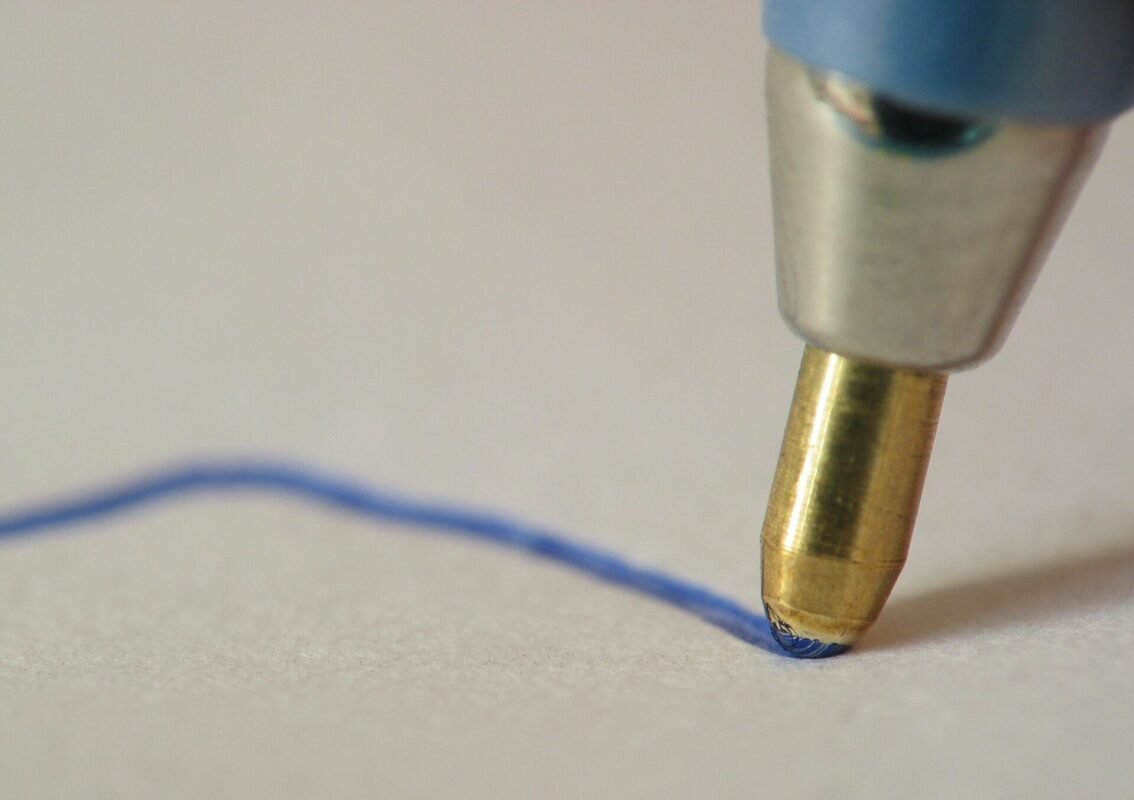
On ballpoint, gel and rollerball pens, the printed size refers to the diameter of the ball at the tip. A 0.7 mm pen has a ball 0.7 millimetres across. The line it draws depends on how much of that ball touches the paper and how much ink spreads, so the line is rarely exactly the same as the number.
Why ballpoint lines are narrower
Thick ballpoint ink is laid down as a thin film and soaks into a narrow track, so a 0.7 mm ballpoint typically draws a line noticeably narrower than 0.7 mm. Many makers state both the ball size and an approximate line width on their packaging.
Gel and liquid inks spread more
Gel and liquid inks lay down more ink, which spreads slightly on the paper, so their lines are closer to, and sometimes appear as bold as, the ball size. A 0.5 mm gel pen often looks bolder than a 0.5 mm ballpoint.
Fineliners and technical pens
Fibre-tip fineliners and technical drawing pens are usually labelled by line width rather than tip diameter. A 0.3 fineliner aims to draw roughly a 0.3 mm line, which is why fineliner sizes look smaller than ballpoint sizes for similar results.
Fountain pen letters
Fountain pen nibs are usually labelled with letters (EF, F, M, B and so on) rather than millimetres. The width depends on the size and shape of the tipping and on how much ink flows, and there is no universal standard. Japanese makers’ nibs commonly run finer than European nibs with the same letter.
Markers
Marker sizes are often given as approximate line widths or descriptive terms such as fine, bullet, chisel and brush. A chisel tip can make thin and broad lines depending on how it is held.
Who this guide is for
- Students choosing pens for notes, revision and exams.
- Parents and teachers helping children find a comfortable pen.
- Office workers who want smoother, neater writing.
- Procurement and admin teams standardising pens for staff and counters.
- Marketing teams choosing promotional pens that write well for everyone.
- Fountain pen users confused by EF, F, M and B.
- Artists, planners and journallers working with fineliners and gel pens.
Ten rules of thumb
- The number on a ballpoint or gel pen is the ball size, not the line width.
- Ballpoint lines are narrower than gel lines of the same size.
- Finer tips are more precise; broader tips are smoother.
- Small handwriting needs finer tips; large handwriting suits broader ones.
- Thin or cheap paper prefers fine tips and ballpoint ink.
- Broad tips use more ink and take longer to dry.
- Left-handers usually do best with fine, quick-drying tips.
- 0.7 mm ballpoint is the safest all-round choice for groups.
- Fountain pen nib letters vary by brand; Japanese nibs often run finer.
- Always test on the paper you actually use.
How to read tip size on a pen or pack
Pen packaging uses a mix of numbers, letters and words. Here is how to decode them.
- A number with “mm” on a ballpoint, gel or rollerball (0.5 mm, 0.7 mm) is usually the ball diameter.
- “Line width” or “stroke width” followed by a number is the approximate width of the line on paper; some makers print both ball size and line width.
- Words such as extra fine, fine, medium, broad and bold are relative to that maker’s range; a “fine” ballpoint and a “fine” gel can differ.
- Letters such as EF, F, M, B on fountain pens describe nib grades, which vary by maker.
- Numbers on fineliners (0.1, 0.3, 0.5) are usually intended line widths.
- Marker descriptions such as bullet, chisel and brush describe the tip shape; some packs add an approximate line width.
- Colour bands or cap colours on some pens indicate ink colour; tip size is often printed on the clip, barrel or refill.
If the size is not printed, look at the refill: many refills carry a tip-size code. When buying online, look for writing samples photographed next to a ruler.
How tip size changes the writing experience
Smoothness
A larger ball has a larger contact area and rolls more easily over the paper’s texture, so broad tips feel smoother. A small ball sits deeper in the paper’s microscopic hills and valleys and transmits more texture to your fingers, which some people describe as scratchy and others as pleasingly precise.
Line width and boldness
Broader tips lay down a wider, darker line that is easy to read from a distance. Finer tips produce thin, crisp lines that keep small letters open and legible.
Ink consumption
A broad tip uses more ink per word. A 1.0 mm refill will usually run out sooner than a 0.5 mm refill of the same size and ink type.
Drying time and smudging
More ink means slower drying. Fine tips dry faster, which helps left-handed writers and fast note-takers.
Feathering and bleed-through
Broad tips, especially with gel and liquid inks, are more likely to feather on absorbent paper and show through thin pages. Fine tips are kinder to cheap or thin paper.
Pressure needed
Broad tips need less pressure to produce a solid line, which reduces hand fatigue. Fine tips may need a little more pressure, particularly with classic ballpoint ink.
Durability
Very fine tips, particularly needle tips, are more delicate and can be damaged by dropping or heavy pressure. Medium and broad tips are more robust.
Precision
Fine and extra-fine tips allow precise placement, ideal for small boxes on forms, technical notes, maths, accounts and annotations. Broad tips, by contrast, are better at filling space confidently, which is why they suit signatures, headings, addresses on parcels and anything that needs to be read from a distance. Most people end up using a medium tip for everyday writing and keeping a fine and a broad pen for the jobs that need them.
| Fine (≈0.5) | Medium (≈0.7) | Broad (≈1.0) | |
|---|---|---|---|
| Smoothness | Good | Very good | Excellent |
| Line | Thin, crisp | Balanced | Bold |
| Precision | Excellent | Good | Fair |
| Ink use | Low | Medium | High |
| Drying | Fastest | Fast | Slower |
| Thin paper | Best | Good | May show through |
| Signatures | Understated | Good | Most confident |
Ballpoint tip sizes
Common sizes
Ballpoint pens are most commonly made in fine (around 0.5 mm), medium (around 0.7 mm) and broad (around 1.0 mm), with some extra-fine and bold options. In India, 0.7 mm is the most familiar everyday size for ballpoints, while many students also like 0.5 mm.
How they write
Because classic ballpoint ink is thick and laid down thinly, ballpoint lines are relatively narrow for their ball size. A 0.7 mm ballpoint gives a neat, medium line that suits most handwriting. A 1.0 mm ballpoint is noticeably smoother and darker and is popular for signatures and for people who dislike scratchy pens.
Low-viscosity ballpoints
Low-viscosity (hybrid) inks lay down more ink, so a 0.7 mm hybrid pen often writes darker and slightly broader than a classic 0.7 mm ballpoint. Many users find a hybrid 0.5 mm as smooth as a classic 0.7 mm.
Choosing a ballpoint size
- 0.5 mm: small handwriting, forms with small boxes, accounts, thin paper.
- 0.7 mm: the safest all-purpose choice for offices, schools and promotional pens.
- 1.0 mm: signatures, large handwriting, users who want maximum smoothness.
Our everyday plastic pens and metal pens are designed around dependable ballpoint tips. For more on ballpoints versus other types, read Ballpoint vs Gel vs Rollerball.

Gel pen tip sizes
Common sizes
Gel pens come in a wider range of sizes than ballpoints, from ultra-fine 0.25–0.3 mm through 0.38 mm and 0.4 mm, the popular 0.5 mm, to 0.7 mm and 1.0 mm.
How they write
Gel ink spreads a little more than ballpoint ink, so gel lines are bolder for the same ball size. A 0.5 mm gel pen is often the sweet spot for students: neat, dark and smooth. 0.38 mm and below are favourites for planners, small notebooks and people with tiny handwriting, but they can feel scratchy and the needle tips are delicate.
Cone vs needle tips
Gel pens often use needle tips for fine sizes: a long, thin metal tube around the ball that lets you see exactly where you are writing. Cone tips are more robust and common at 0.5 mm and above.
Choosing a gel size
- 0.25–0.38 mm: tiny handwriting, planners, annotating textbooks, maths.
- 0.5 mm: everyday notes, exams, journalling.
- 0.7 mm: bold notes, headings, users who want maximum smoothness.
- 1.0 mm: signatures, cards, headings, colour on dark paper.

Why fine tips feel scratchy and broad tips feel smooth
Paper is rough at small scales
Even smooth-looking paper is a landscape of fibres, fillers and tiny gaps. A large ball rides over the tops of these features like a big wheel over cobblestones. A small ball dips into the gaps and bumps over each fibre, which you feel as feedback or scratchiness.
Contact area and pressure
For the same hand pressure, a smaller ball concentrates force on a smaller area, so it presses deeper into the paper. More friction and more feeling follow. A broader ball spreads the force and rolls more easily.
Ink film
Broader tips carry more ink, and that ink acts as a lubricant between ball and paper. Fine tips carry less, so there is less cushioning.
Writing angle
Fine tips, especially needle tips, are more sensitive to angle. Held too low, the rim of the tip can touch the paper and scrape. Holding a fine pen a little more upright often makes it feel much smoother.
Ink type
Ink can compensate for tip size. A fine tip with smooth gel or low-viscosity ink can feel smoother than a medium tip with classic thick ballpoint ink. When people say they need a broad tip for comfort, a smoother ink in a medium tip is often the better solution.
Quality of manufacture
Precision matters more as tips get smaller. Small imperfections in the ball or rim make a bigger difference at 0.38 mm than at 1.0 mm. Fine pens from reliable makers write noticeably better than cheap ones.
Tip size and legibility
Letter openness
The enclosed spaces in letters such as a, e, o, g and the numbers 6, 8 and 9 need to stay open to be read. If the line is too broad for the size of your writing, they close up. A useful check: write a line of small e’s and a’s; if the holes fill in, choose a finer tip.
Contrast
Broader, darker lines have more contrast with the paper and are easier to read in poor light and from a distance. Very fine, pale lines can be hard on the eyes, especially for older readers.
Scanning and copying
Very fine lines can break up or disappear in scans and photocopies. For forms that will be scanned, 0.5–0.7 mm in black or dark blue usually reproduces best.
Reading distance
Notes read at a desk can be fine; signs, labels and whiteboard writing read from across a room need broad markers.
Tip size in real-world conditions
Hot and humid weather
In humid monsoon weather, paper absorbs more ink and water-based inks dry more slowly. Broad gel and liquid tips are most affected, feathering and smudging more than usual. Stepping down a size, for example from 0.7 to 0.5 mm gel, often restores crisp lines. In very hot weather, thin inks also flow more freely, so a pen that felt just right in winter may feel wetter and bolder in summer.
Cold weather
Cold thickens ink, making fine ballpoint tips more likely to start slowly. Medium tips and smoother inks start more reliably; warming the pen in your hand helps.
Writing on the move
On trains, in cars or standing up with a clipboard, a medium cone tip is the most forgiving. Fine needle tips catch more easily on uneven surfaces, and broad wet tips smudge when pages are handled quickly.
Writing on soft surfaces
Writing on a pad of paper, on your knee or on a soft desk mat lets the ball sink slightly, which can make fine tips feel smoother and broad tips feel heavier. A firm backing board gives the most consistent results.
Writing upright
Writing on a wall, a vertical board or overhead calls for pressurised refills; tip size matters less than ink delivery in these positions.
Rollerball tip sizes
Rollerballs are commonly sold in fine (around 0.5 mm) and medium (around 0.7 mm) sizes. Because liquid ink flows freely and soaks into paper, rollerball lines are bold and often appear wider than the ball size. A 0.5 mm rollerball gives a line that many people find similar to a medium ballpoint. On thin or absorbent paper, choose the finer size to limit feathering and show-through. For signatures and letters, a medium rollerball gives a rich, confident line. See our Aero Flow liquid-ink pens.
Fountain pen nib sizes
The letter system
| Nib | Name | Typical use |
|---|---|---|
| UEF / EF | Ultra-extra fine / Extra fine | Very small handwriting, annotations, poor paper |
| F | Fine | Everyday notes, small handwriting, beginners |
| MF | Medium-fine | Between fine and medium (common on Japanese pens) |
| M | Medium | Everyday writing, letters, journals |
| B | Broad | Signatures, large handwriting, showing ink |
| BB / OB | Double broad / Oblique broad | Expressive writing, specialist use |
| Stub | Stub | Line variation for everyday handwriting |
| Italic | Cursive or crisp italic | Calligraphic handwriting |
| 1.1 / 1.5 / 1.9 mm | Calligraphy (broad-edged) | Calligraphy practice |
Japanese vs European sizing
There is no international standard for fountain pen nib widths. Many Japanese makers produce finer nibs than European makers for the same letter, partly because Japanese and Chinese characters have many fine strokes. A Japanese medium can write close to a European fine. If you are buying online, look for writing samples or ask the seller.

Ink and paper change the line
A fountain pen’s line width depends on more than the nib. A wet ink spreads more; absorbent paper widens the line; writing pressure and speed matter too. The same nib can look a full size broader on cheap paper with a wet ink.
Choosing a nib size
- EF/F: small handwriting, everyday notes on ordinary paper, beginners, left-handers.
- M: most people’s ideal everyday nib on good paper; shows ink colour and shading.
- B: signatures, cards, large handwriting, enjoying ink.
- Stub/italic: character and line variation once you are comfortable with fountain pens.
New to fountain pens? Start with our Fountain Pens for Beginners guide.
Nib shapes
Most nibs are round, writing the same width in all directions. Stub nibs are flattened slightly so downstrokes are broader than cross-strokes. Italic nibs are flatter and sharper, giving stronger contrast. Oblique nibs are ground at an angle to suit writers who rotate the pen. Flex nibs spread under pressure for dramatic variation. Each needs a little practice.
Fineliner and technical pen sizes
Fineliners and technical drawing pens are labelled by intended line width, commonly from around 0.05 mm up to 0.8 mm or more, with 0.1, 0.3 and 0.5 being popular. Technical drafting pens have traditionally followed standardised line-width series so drawings stay consistent. Artists use several sizes in one drawing: fine for detail and hatching, medium for outlines, broad for emphasis. Fibre tips can wear and broaden with heavy pressure, so a light touch keeps lines consistent.
Marker and highlighter tip types
| Tip | Shape | Use |
|---|---|---|
| Ultra-fine / extra-fine | Thin round fibre | Labelling small items, CDs, cables |
| Fine | Round | Labels, notes, outlines |
| Bullet | Rounded cone | General marking, whiteboards, signs |
| Chisel | Wedge | Thin and broad lines; highlighters, signs, cartons |
| Brush | Flexible | Lettering and art |
| Jumbo | Very broad | Large signs, industrial marking |
Chisel tips are the most versatile: hold them flat for a broad stroke, on edge for a thin one. That is why most highlighters use them.

Tip sizes across different pens
Everyday plastic pens
Most everyday plastic ballpoint pens use medium tips around 0.6–0.7 mm, a size that suits most handwriting and makes pens dependable on all kinds of paper. Some ranges offer fine versions for students and accountants. Our plastic pens, such as Elite and Aurora, are designed for smooth everyday writing.
Metal pens
Metal twist and click pens often use standard metal refills that come in several tip sizes, so you can change from medium to fine or broad without changing the pen. Premium metal pens for gifting usually ship with a medium refill that writes confidently. See our metal pens.
Multi-pens
Multi-pens use slim refills, commonly in 0.5 and 0.7 mm, and sometimes finer gel options. Because the refills are interchangeable, you can mix sizes in one pen: a fine black for writing, a medium red for marking.
Liquid-ink and rollerball pens
Liquid-ink pens are typically offered in 0.5 and 0.7 mm. Because liquid ink spreads, a 0.5 mm liquid-ink pen often writes as boldly as a medium ballpoint, so many people find the finer size best for everyday use.
Fountain pens
Fountain pens use lettered nib grades. Starter pens often come in fine or medium; premium pens offer a broader range and special grinds.
Mechanical pencils: a useful comparison
Mechanical pencils are labelled by lead diameter, commonly 0.3, 0.5, 0.7 and 0.9 mm, and those numbers are close to the actual line width. If you like a particular pencil size, it can be a helpful guide: someone who loves 0.5 mm pencils will often enjoy a 0.38–0.5 mm gel pen, while a 0.7 mm pencil fan may prefer a 0.5–0.7 mm ballpoint.
Markers and highlighters
Marker sizes are mostly described by tip shape, fine, bullet, chisel, brush, rather than a single number. For labelling, a fine or bullet tip is most versatile; for signs, a chisel tip.
Changing tip size with refills
One of the easiest ways to change how a pen writes is to choose a different refill in the same format with a different tip size. Many standard refill formats are made in fine, medium and broad versions and in ballpoint, hybrid and gel inks. Before buying, check that the refill matches your pen’s format, length and end fitting, and that the new tip size suits your handwriting. For identifying formats, see Pen Refills Explained.
Tip size, pen weight and balance
Tip size and pen body work together. A heavy metal pen with a broad tip glides under its own weight and can feel effortless for signatures and long letters; the same body with an ultra-fine tip may feel unbalanced, because the weight pushes a tiny ball into the paper. A light plastic pen with a fine tip encourages precise, controlled writing, which suits notes and forms; with a very broad tip, a light pen can feel as if it is skating across the page. When choosing a pen for long writing sessions, try the combination rather than the tip alone: hold the pen as you normally would, write a full paragraph, and notice whether your hand relaxes or tenses. Thicker barrels generally pair well with medium to broad tips, slim barrels with fine to medium.
Choosing tip size by handwriting
Small handwriting
If your lower-case letters are small, a broad tip will fill in the loops of letters such as a, e and o, making writing look heavy and hard to read. Choose 0.5 mm or finer in ballpoint and gel, or EF/F in fountain pens.
Average handwriting
Most people write comfortably with 0.5–0.7 mm. Try both: 0.5 if you like crispness, 0.7 if you value smoothness.
Large handwriting
Large letters look better with a broader line. A 0.7–1.0 mm ballpoint or gel, or an M/B fountain nib, keeps writing proportionate and feels smoother over long strokes.
Fast writers
Fast writers often prefer medium or broad tips, which glide with less resistance. But faster writing also means less time for ink to dry, so pair a broader tip with quick-drying ink.
Heavy-handed writers
If you press hard, fine and needle tips can feel scratchy and may be damaged. A medium cone tip with ballpoint ink is robust and comfortable. Also try consciously reducing pressure with a smoother ink.
Light-handed writers
Light pressure works best with broader tips and smooth inks such as gel, hybrid or liquid, which deliver a solid line without force.
Left-handed writers
Finer tips lay down less ink, so it dries sooner and smudges less. A 0.5 mm hybrid or ballpoint is a popular choice.
People with hand pain or arthritis
Broader, smoother tips need less pressure, and thicker pen bodies need less pinching. A 0.7–1.0 mm hybrid or gel pen in a wide, cushioned body can make writing far more comfortable.
Choosing tip size by paper
| Paper | Best tip size | Why |
|---|---|---|
| Thin exam sheets | 0.5 mm ballpoint or fine gel | Less show-through |
| Ordinary office paper | 0.5–0.7 mm | Balanced line and drying |
| Cheap school notebooks | 0.5–0.7 mm ballpoint or hybrid | Avoid feathering |
| Good diaries and notebooks | Any; broad gel and M/B fountain nibs shine | Paper handles more ink |
| Forms with small boxes | 0.5 mm or finer | Precision |
| Carbon and duplicate forms | 0.7 mm ballpoint with firm pressure | Transfers clearly |
| Glossy and coated paper | Fine gel or permanent fineliner | Dries faster than broad wet lines |
| Cards and envelopes | 0.7–1.0 mm | Bold, readable addresses |
Explore paper that suits every tip size in our diaries, notebooks and planners.

Choosing tip size by task
| Task | Recommended size |
|---|---|
| Lecture and class notes | 0.5 mm gel or hybrid |
| Board and university exams | 0.5–0.7 mm, tested beforehand |
| Daily office work | 0.7 mm ballpoint or hybrid |
| Signatures | 0.7–1.0 mm ballpoint, gel or rollerball; M/B fountain |
| Accounts, ledgers, maths | 0.38–0.5 mm |
| Planners and bullet journals | 0.3–0.5 mm gel or fineliner |
| Textbook annotation | 0.38 mm gel or fine ballpoint |
| Letters and cards | 0.7 mm rollerball or M fountain |
| Addressing parcels | 1.0 mm ballpoint or fine marker |
| Technical sketches | 0.1–0.5 mm fineliners |
| Whiteboards and signs | Bullet or chisel markers |
| Highlighting | Chisel highlighter |
| Promotional giveaways | 0.7 mm ballpoint or hybrid |
| Executive gifts | 0.7–1.0 mm rollerball/ballpoint, M fountain |
Tip size for exams
Exams combine three demands: speed, neatness and endurance. Most students do best with a 0.5 mm gel or hybrid pen, which gives neat, dark writing with little effort. Students with large handwriting or heavy hands may prefer 0.7 mm. Whatever you choose:
- Use the same tip size and pen you practised with.
- Test on paper similar to the answer sheets, checking show-through.
- Carry at least two identical pens.
- Avoid ultra-fine needle tips, which can be scratchy and delicate under exam pressure.
- Follow your board’s colour rules.
More tips in The Best Pens for Exams and Best Ball Pen for Students.
Tip size for signatures
A signature is about presence. A broad tip (0.7–1.0 mm, or an M/B fountain nib) gives a confident, fluid line that looks deliberate. Fine tips can make signatures look hesitant. On documents with small signature boxes, a medium tip is the practical compromise. Always use permanent ink for documents.
Tip sizes for different professions
Doctors and healthcare workers
Prescriptions, charts and forms involve small boxes, carbon copies and fast writing. A 0.5–0.7 mm ballpoint or hybrid gives neat, quick-drying writing that copies through duplicate forms. Clear, legible writing on prescriptions matters for patient safety, which makes a medium-fine tip and dark ink a sensible choice.
Lawyers and legal staff
Annotating dense documents calls for fine tips (0.38–0.5 mm); signing calls for a broader, confident line. Many keep one of each.
Accountants and finance teams
Ledgers, spreadsheets on paper and small columns of numbers favour 0.38–0.5 mm, often in multi-pens with several colours. Numbers must stay unambiguous, so avoid tips that close up the loops of 6, 8 and 9.
Teachers
Marking in margins needs fine to medium tips in red or green; writing comments on assignments benefits from a smooth 0.5–0.7 mm. Whiteboard markers in bullet or chisel tips complete the kit. See pen gifts for teachers.
Engineers and architects
Fineliners in graded sizes for drawings, fine ballpoints for site notes, and markers for labelling samples and drawings.
Designers and illustrators
A range of fineliners from 0.05 to 0.8, brush pens for expressive lines, and markers in several tip shapes.
Writers and journalists
Speed and comfort dominate: a smooth 0.7 mm hybrid or 0.5 mm gel for notes, plus a favourite fountain pen for drafting.
Front desks, banks and counters
A sturdy 0.7 mm blue or black ballpoint, often tethered, that works for every customer on every form.
Logistics and warehouses
Permanent markers with bullet and chisel tips for cartons, and 0.7 mm ballpoints for delivery notes and dockets.
Executives
Smooth medium to broad rollerball, gel or fountain pens for signing, plus a reliable everyday pen for notes. Premium metal pens make good gifts for this group; see Choosing the Right Pen for Executive Gifting.

Tip sizes for planners and journals
Planners and journals have their own demands: small daily boxes, dense lists, decorative headings and colour coding.
Daily and weekly planners
Small calendar boxes favour 0.3–0.4 mm gel pens or 0.1–0.3 fineliners, which keep appointments readable in tight spaces. Choose quick-drying inks so pages can be turned immediately.
Bullet journals
A typical bullet journal kit includes a 0.3 or 0.5 fineliner for body text, a 0.8 or brush pen for headings, and a few coloured gel pens or highlighters for coding.
Writing journals
For flowing prose, comfort matters more than precision. A 0.5–0.7 mm gel or a medium fountain nib on good paper makes long entries enjoyable.
Colour coding
Use the same tip size across colours so the page looks consistent, and choose pale highlighter tones that do not overwhelm fine writing.
Paper check
Planner paper is often thin to keep the book compact. Test broad and liquid-ink pens on a back page before using them throughout. See our planners and diaries.
Tip sizes for note-taking and study
Good study notes need to be fast to write and easy to review weeks later. A 0.5 mm gel or hybrid in black or blue works well for the main text. Add a red or green 0.5 mm pen for key terms and corrections, and a chisel highlighter for the most important points. For diagrams and formulas, a 0.38 mm pen keeps small labels legible. Keep headings slightly bolder, with a 0.7 or 1.0 mm pen, so the structure of your notes is visible at a glance. Using consistent sizes and colours throughout a subject notebook makes revision noticeably quicker.
Inside a ball tip
Ball
The ball is usually tungsten carbide or stainless steel, made to very tight tolerances. Its diameter defines the tip size.
Socket and seat
The ball sits in a socket machined into the tip. Channels behind the ball carry ink to its upper surface. As tip size changes, the socket and channels are re-engineered so ink flow matches the ball.
Rim
The front edge of the tip is formed around the ball to hold it in place. How much of the ball protrudes affects the writing angle and smoothness.
Cone and needle shapes
A cone tip tapers gradually and is robust. A needle tip is a long thin tube that gives a clear view of the writing point, popular for fine gel pens. Needle tips can bend if dropped.
Tip material
Brass and nickel silver are common for ballpoint tips; stainless steel is typical for gel and liquid inks because it resists corrosion.
For more detail on how tips and refills are built, see Pen Refills Explained.

Inside a fountain pen nib
A fountain pen nib’s line width is set mainly by the tipping, a tiny bead of very hard alloy welded to the end of the nib and ground to shape. An extra-fine nib has a small, finely ground tipping; a broad nib has a larger bead. The slit between the tines carries ink; how far the tines are spaced and how wet the feed is also influence width. The shape of the grind, round, stub, italic or oblique, decides whether the line is uniform or varies with direction.

Typical line widths
Line widths vary by ink, paper and maker, but these rough ranges help set expectations.
| Pen and label | Approximate line |
|---|---|
| Ballpoint 0.5 mm | Fine; noticeably narrower than 0.5 mm |
| Ballpoint 0.7 mm | Medium-fine |
| Ballpoint 1.0 mm | Medium-bold |
| Gel 0.38 mm | Very fine |
| Gel 0.5 mm | Fine-medium, bold for its size |
| Gel 0.7 mm | Bold |
| Rollerball 0.5 mm | Medium |
| Fineliner 0.3 | About 0.3 mm |
| Fountain EF (Japanese) | Very fine |
| Fountain F (European) | Fine-medium |
| Fountain M (European) | Medium-broad |
Always look at actual writing samples when choosing, and test on your own paper.
How to test tip sizes
- Write the same sentence with each pen on the paper you use most.
- Check legibility at arm’s length: are small letters open and clear?
- Feel the smoothness over a full paragraph, not just a scribble.
- Turn the page to check show-through.
- Swipe a finger across the writing after a few seconds to test smudging.
- Write fast for a minute to see whether lines skip or thin out.
- Sign your name to see which size looks most confident.
- Ask others which sample is easiest to read.
For teams, test two or three sizes with a few users before ordering in bulk. See Buying Pens in Bulk.

Running a tip-size trial for a group
For schools, offices and events, a short trial avoids buying the wrong size in bulk. Choose two or three candidate pens that differ only in tip size, give each to a handful of users for a few days, and ask them three questions: which felt most comfortable, which made their writing easiest to read, and which they would keep using. Collect a sample page from each person. You will usually find a clear favourite, often the medium, with a minority who prefer fine. Ordering mostly the favourite, plus a smaller quantity of the alternative, keeps nearly everyone happy and avoids drawers full of unused pens.
Troubleshooting by tip size
| Problem | Likely tip-related cause | Try |
|---|---|---|
| Pen feels scratchy | Tip too fine; writing angle too low | Hold more upright; try a broader tip or smoother ink |
| Letters fill in | Tip too broad for handwriting size | Go one size finer |
| Writing looks faint | Very fine ballpoint; light pressure | Try a hybrid or gel at the same size, or a broader tip |
| Smudging | Broad tip laying down too much ink | Finer tip; quicker-drying ink |
| Show-through on thin paper | Broad gel or liquid tip | Fine ballpoint |
| Skipping | Fine tip on glossy paper; dirt on ball | Clean tip; medium tip; different paper |
| Needle tip stopped writing | Bent tip after a drop | Replace the refill |
| Hand fatigue | Fine tip with thick ink needs pressure | Broader tip, smoother ink, thicker body |
| Refill runs out fast | Broad tip; gel or liquid ink | Finer tip or ballpoint ink |
Caring for fine tips
- Retract or cap immediately after use; fine tips dry and clog more easily.
- Avoid drops, especially tip-first onto hard floors; needle tips bend easily.
- Don’t press hard; let the ink do the work.
- Keep tips clean; wipe away fibres and dust that collect around the ball.
- Write on suitable paper; very rough or fibrous paper wears fine fibre tips quickly.
- Store gel pens as the maker recommends to keep ink at the tip.
- Use fine fineliners lightly; pressure flattens fibre tips and broadens the line permanently.
Tip size myths
“0.5 mm means a 0.5 mm line.”
Not for ballpoint, gel or rollerball. The number is the ball diameter; the line varies with ink and paper.
“Finer always looks neater.”
Only if your handwriting is small. Large handwriting with an ultra-fine tip can look spidery and faint.
“Broad tips are only for signatures.”
Many people with large handwriting or hand pain write all day with 1.0 mm pens and love them.
“All mediums are the same.”
A medium ballpoint, a medium gel and a medium fountain nib produce very different lines, and fountain nib sizes vary by country of origin.
“Scratchy means low quality.”
Some feedback is natural with fine tips. But excessive scratchiness, skipping or blobs on good paper do point to a poor tip.
“Children need the finest tip for neat writing.”
Young children usually do better with medium tips that glide easily and are more robust; neatness comes from practice and comfort.
Writing angle and grip for each tip size
Fine and needle tips
Hold fine tips a little more upright, around 60 to 70 degrees to the paper, so the ball, not the rim, meets the page. Use a light grip and let the pen move with your fingers. If the pen catches, raise the angle slightly rather than pressing harder.
Medium tips
Medium cone tips are forgiving and write well across a wide range of angles, from about 45 to 70 degrees. This tolerance is one reason medium tips suit shared pens and promotional pens: everyone holds a pen differently.
Broad tips
Broad tips glide at lower angles and need very little pressure. Relax the grip and let the pen’s weight do the work; pressing hard with a broad tip just lays down extra ink and slows drying.
Fountain nibs
Fountain nibs write best at a lower angle, often around 40 to 55 degrees, with the nib’s top facing up. Finer nibs are more sensitive to rotation; if a fine nib feels scratchy, check that it is not rolled to one side.
Markers and chisel tips
Hold chisel tips at a consistent angle to keep strokes even; flat for broad strokes, on edge for thin lines.
Tip size and writing speed
When speed matters, in lectures, interviews, meetings and exams, broader and smoother tips help because they need less pressure and glide over the paper. But speed also increases the risk of smudging and of letters running together. The best balance for most fast writers is a 0.5 mm gel or hybrid, or a 0.7 mm low-viscosity ballpoint: smooth enough to keep up, fine enough to keep letters distinct, and quick-drying enough to avoid smears. Very fine tips tend to slow writers down because they demand more care and can catch on paper.
Same size, different pens: a worked example
Imagine writing the same sentence with four pens all labelled 0.5 mm:
- 0.5 mm classic ballpoint: a thin, light line; very quick drying; some feedback; excellent on thin paper.
- 0.5 mm hybrid ballpoint: darker and smoother; still quick drying; a great everyday compromise.
- 0.5 mm gel: noticeably bolder and more vivid; very smooth; slower to dry; may show through thin paper.
- 0.5 mm liquid-ink rollerball: the boldest and wettest; the smoothest feel; most likely to feather on cheap paper.
The label is the same, but the results are very different. This is why choosing tip size and ink type together, and testing them, matters more than reading numbers alone. See Pen Ink Types Explained.
Tip sizes for children
Children’s hands, handwriting and paper are different from adults’, so their pens should be too.
Early writers
Children moving from pencil to pen are still developing control and often press hard. A robust medium tip (around 0.7 mm) with a smooth, quick-drying ink is forgiving: it glides without much pressure, survives being pressed and dropped, and gives a clear line that helps children see their letter shapes. Very fine needle tips are easily damaged and can catch on paper.
Middle school
As handwriting becomes smaller and faster, many children move to 0.5 mm. Gel and hybrid inks at this size are popular because they write darkly with little effort. Encourage children to try two sizes and choose the one that keeps their writing neat without strain.
Senior school
Older students often settle on a favourite size for notes (commonly 0.5 mm gel) and a dependable pen for exams. They may add finer pens for diagrams and maths, and a highlighter set for revision.
Fountain pens for children
When schools introduce fountain pens, a fine steel nib with washable blue ink and cartridges is usual. A fine nib keeps letters neat on school notebook paper and limits feathering.
Signs a child needs a different size
- Letters fill in or look blotchy: try finer.
- The pen tears the paper or the child grips very tightly: try broader and smoother.
- Writing looks faint and the child presses hard: try a smoother ink at the same size.
- Smudging on the hand (left-handers): try finer and quicker drying.
See Best Ball Pen for Students and Best Pen for Good Handwriting.
Tip sizes for organisations
Choose one default
For pens shared by many people, at counters, reception desks, training rooms and events, a 0.7 mm ballpoint or hybrid is the safest default, and it is the size most people already expect from an everyday pen. It suits most handwriting, works on forms and copies, dries quickly and is robust.
Offer a fine option where needed
Accounts, data entry and teams filling small forms may prefer 0.5 mm. Stocking a small quantity of fine pens alongside the default keeps everyone comfortable and avoids staff buying their own pens because the standard issue does not suit them.
Executives and signatories
Leaders who sign frequently often prefer 0.7–1.0 mm rollerball, gel or fountain pens. Premium metal pens with smooth refills suit this group; see our premium metal pens.
Specialist teams
Stores and logistics need markers with bullet or chisel tips; designers need fineliners in several sizes; field teams may need pressurised pens.
Put it in the specification
When ordering in bulk, state the tip size, the ink type and how line width will be checked on samples. A single line in a purchase order, “0.7 mm blue ballpoint, line tested on our A4 copy paper”, prevents many disappointments. See Buying Pens in Bulk.
Tip size for promotional pens
Promotional pens reach people with every kind of handwriting, so they must write well for everyone on the first try. That points to a smooth 0.7 mm ballpoint or hybrid: broad enough to feel smooth, fine enough for forms, quick-drying and long-lasting. Very fine tips risk feeling scratchy to many users; very broad tips can blot on cheap paper. Combine the right tip with a reliable mechanism and a clear print area for the logo. See Smooth-Writing Pens and Ink Flow, Pen Branding Methods and branded pens for events.
Tip size preferences in India
In India, 0.7 mm ballpoints have long been the everyday standard in offices and many schools, with 0.5 mm common among students who prefer neater, smaller writing. Gel pens at 0.5 mm are popular for notes and exams, and fine tips are favoured for the long, dense answers of board and university exams. Smoothness is increasingly expected at every price point, which is why low-viscosity inks in familiar 0.6–0.7 mm sizes have grown in popularity. For signatures and executive gifts, broader rollerballs and fountain pens remain the classic choice.
A short history of tip sizes
Quills and steel nibs
Before ball tips, line width was controlled by how a quill or steel dip nib was cut. Scribes and clerks cut or chose nibs to suit their script, from fine pointed nibs for copperplate to broad-edged nibs for formal hands. Steel nib makers in the nineteenth century produced hundreds of nib patterns for different jobs.
Fountain pen nibs
As fountain pens became common, manufacturers settled on letter grades such as fine, medium and broad, and added specialist grinds. Each maker defined these sizes for itself, which is why nib widths still vary between brands and regions.
The ballpoint and standard ball sizes
The ballpoint, patented by László Bíró in 1938, introduced a new way to set line width: the size of the ball. Mass production after the Second World War made medium ballpoints the everyday pen, and fine and broad versions followed. International standards for ballpoint pens and refills, ISO 12757, later defined test methods and interchangeable refill types, helping refills and tips become more consistent across makers.
Fine-tip culture
From the 1980s, gel pens, particularly from Japanese manufacturers, pushed tip sizes ever finer, to 0.38 mm, 0.3 mm and below, driven by students and writers who wanted precise, small writing in planners and dense notes. Needle tips made those fine sizes practical.
Technical pens and fineliners
Engineers and architects needed exact, repeatable line widths for drawings, leading to technical drawing pens with standardised line widths and, later, disposable pigment fineliners in graded sizes.
Today
Modern writers can choose from a wider range of tip sizes than ever: from 0.25 mm gels to 1.6 mm ballpoints, from extra-fine fountain nibs to broad calligraphy edges. The challenge is no longer availability, but knowing which size suits you. For the broader story of pens in India, see The Evolution of Pen Manufacturing in India.
Nib widths for calligraphy and lettering
Broad-edged nibs
Broad-edged calligraphy nibs, whether fountain pen italics or dip nibs, are measured by the width of the edge, often 1.1, 1.5, 1.9, 2.3 mm or more. The edge makes thick strokes when pulled across its width and thin strokes when moved sideways along its edge.
Choosing a width
Calligraphy letter heights are measured in nib widths. A typical italic hand might have an x-height of around five nib widths. That means a broader nib produces larger letters. Beginners often start around 1.5 mm or wider because larger letters are easier to study and correct.
Brush pens
Brush pens create thin upstrokes with light pressure and thick downstrokes with more pressure. Small brush tips suit compact lettering; large brushes suit headings and posters.
Monoline lettering
Fineliners and gel pens create monoline (uniform width) lettering. A 0.5–0.8 mm line is easy for beginners; finer tips suit small, detailed work.
Faux calligraphy
You can mimic brush lettering with any fine or medium pen by drawing letters, then thickening the downstrokes with a second line and filling the gap. It is a popular technique for cards and journals.

Line weight for drawing
Artists use several tip sizes to create depth and hierarchy in a drawing. A common approach is to use the broadest line for outer contours and objects in the foreground, medium lines for interior shapes, and the finest lines for texture, shading and distant details. Hatching with a 0.1 or 0.2 mm fineliner creates subtle tones; a 0.8 mm line makes shapes stand out. Changing pressure is not an option with most fineliners, so switching sizes is how artists vary line weight.
Using tip size to improve your handwriting
Changing tip size is one of the quickest ways to improve how your handwriting looks and feels.
Step 1: Measure your x-height
Write a normal sentence and look at the height of your lower-case letters without ascenders or descenders, such as a, c, e, m, n, o. If they are about 2 mm tall or less, you have small handwriting; around 3 mm is average; 4 mm or more is large.
Step 2: Match the line to the letter
As a rough guide, small handwriting looks best with lines around 0.3–0.4 mm, average handwriting with 0.4–0.5 mm, and large handwriting with 0.5 mm and above. Remember that a 0.7 mm ballpoint often draws a line around half a millimetre or less, while a 0.5 mm gel can be similar.
Step 3: Check the counters
The enclosed spaces in letters are called counters. Write a row of a, e, o, g, 6, 8 and 9. If the counters fill in, go finer; if the writing looks thin and wiry, go broader.
Step 4: Check comfort over a page
Neatness is no use if your hand aches. Write a full page and notice tension. If a fine tip makes you press, try the same size in a smoother ink, or step up a size.
Step 5: Slow down slightly
A smoother, broader tip often encourages a more relaxed, flowing hand; a fine tip encourages precision. Try both and notice which leads to more consistent letters for you.
Step 6: Use good paper and ruling
Narrow-ruled paper suits small writing and fine tips; wide-ruled suits larger writing and broader tips. Matching ruling to your letter size makes writing look more even.
Step 7: Practise with your chosen pen
Five or ten minutes a day of deliberate writing practice with the pen you have chosen will do more than any equipment change. See Best Pen for Good Handwriting for exercises.
Building a small multi-size pen kit
Many people find that one size cannot do everything. A small kit of three or four pens covers most needs without clutter:
- Everyday writer: 0.5 or 0.7 mm hybrid or gel in blue or black for notes and forms.
- Fine detailer: 0.38 mm gel or 0.3 fineliner for small boxes, diagrams, annotations and planners.
- Signature pen: 0.7–1.0 mm rollerball, gel or a medium fountain pen for signing and cards.
- Marker: a fine bullet or chisel marker for labels, envelopes and signs.
- Highlighter: chisel tip for reading and revision.
Keep the kit in a pen pouch or desk tray so the right tip is always at hand. Gift sets that combine a pen with a diary or organiser are a neat way to put together such a kit for staff or clients; see our gift sets.
Quick decision guide
- Small handwriting or thin paper? Choose 0.5 mm or finer (EF/F fountain).
- Average handwriting, general use? Choose 0.7 mm ballpoint or 0.5 mm gel/hybrid.
- Large handwriting, light touch or hand pain? Choose 0.7–1.0 mm smooth ink.
- Left-handed? Choose fine and quick-drying.
- Signatures and cards? Choose broad (0.7–1.0 mm; M/B fountain).
- Forms with small boxes or accounts? Choose 0.38–0.5 mm.
- Drawing or planners? Choose fineliners in two or three sizes.
- Pens for many people? Choose 0.7 mm ballpoint or hybrid.
Tip sizes for different scripts
India writes in many scripts, and tip size affects each a little differently.
Devanagari (Hindi, Marathi, Sanskrit and others)
Devanagari letters hang from a continuous headline and include many small curves, loops and vowel signs above and below the line. A medium-fine tip (around 0.5 mm in gel or 0.7 mm in ballpoint) keeps loops and matras clear while drawing a solid headline. Very broad tips can fill in small curves; very fine tips can make the headline look faint.
Bengali, Gujarati, Gurmukhi and other North Indian scripts
These scripts also combine curves and small marks. Medium-fine tips usually give the best balance between legibility and smoothness.
Tamil, Telugu, Kannada and Malayalam
Rounded letterforms with many loops benefit from tips that keep counters open, so fine to medium-fine tips are a good default, especially for smaller handwriting.
Urdu
Urdu, traditionally written with a broad-edged reed pen in Nastaliq style, gains character from line variation. In everyday handwriting with ballpoints and gel pens, a medium tip gives smooth curves; for calligraphy, broad-edged nibs or markers are used.
English and other Latin-script languages
Latin script tolerates a wide range of tip sizes; choose by handwriting size as described above.
Mixed-script writing
Many people in India write in two or three scripts in a day. A smooth 0.5 mm gel or 0.7 mm hybrid ballpoint is a versatile choice that suits most scripts well.
Tip size and running cost
Tip size affects how long a refill lasts, and so how much your writing costs over a year. A broad tip lays down more ink per word, so a refill runs out sooner; a fine tip stretches the same ink further. Ink type matters too: classic ballpoint ink lasts longest, gel and liquid inks the least.
For individuals, the difference is small. For organisations buying thousands of pens or refills, it adds up. Choosing a 0.7 mm classic or hybrid ballpoint for general staff, and reserving broad gel or liquid-ink pens for those who need them, keeps costs predictable without compromising comfort. Track how many refills each team uses for a few months to set reorder quantities. For more, see How Long Does a Dyna Pen Last?
Tips for retailers
- Stock the core sizes: 0.5 and 0.7 mm in blue and black cover most demand; add 0.38 and 1.0 for students and signers.
- Offer tester pads so customers can try sizes on paper.
- Label line width where possible, not just ball size.
- Explain the difference between ballpoint and gel sizes to customers.
- Bundle a fine and a medium pen for students before exams.
- Keep refills in matching sizes next to the pens, so customers can upgrade or downsize their favourite pen on the spot.
Interested in stocking DYNA pens? See Become a Partner.
Choosing tip size for gift pens
When you choose a pen for someone else, you rarely know their handwriting. A few simple rules help.
- Default to medium. A 0.7 mm ballpoint or rollerball, or an M fountain nib, suits the widest range of handwriting and feels smooth.
- Students and young professionals: fine (0.5 mm) is often preferred for notes and small writing.
- Senior executives and signatories: medium to broad for confident signatures.
- Fountain pen gifts: medium for Western-style nibs; if the pen runs fine, a medium is safer still.
- Include a spare refill in a different size if the pen accepts standard refills, so the recipient can choose.
- Engraving and packaging make the gift personal; see personalised pen gifts and gift sets.
Tip size for older writers and accessibility
Reduced grip strength
People with arthritis, reduced grip strength or tremor often find broad, smooth tips far easier to use, because they need little pressure. Combine a 0.7–1.0 mm hybrid, gel or liquid-ink tip with a thicker, cushioned body.
Reduced vision
Bolder, darker lines are easier to see and read back. A broad black or dark blue line on bright white paper offers the highest contrast. For notes and lists that must be read easily, a fine marker can be even better.
Tremor
Heavier pens and broader tips can steady writing for some people with tremor. Smooth inks reduce the effort needed to form each stroke.
Children with handwriting difficulties
Children who find writing hard often benefit from a smooth medium tip, a comfortable grip and wide-ruled paper. Occupational therapists can advise on specific needs.
Forms for everyone
Public counters serve people of all ages and abilities. A smooth 0.7 mm ballpoint with a comfortable body is the most inclusive choice for shared pens.
Ordering pens by tip size: a checklist
- Who will use the pens? Students, staff, customers, executives, field teams.
- What will they write? Notes, forms, signatures, labels, drawings.
- On what paper? Thin exam sheets, copy paper, duplicate forms, diaries, cartons.
- Which ink? Classic ballpoint, hybrid, gel or liquid; each changes the effective line width.
- Which size? 0.7 mm ballpoint/hybrid as the default for groups; 0.5 mm for fine work; broad for signing.
- Which colour? Blue or black for most uses; red and green for marking.
- Samples: request samples in two sizes and test them with real users on real paper.
- Specification: write the tip size and ink type into the purchase order.
- Refills: order matching refills in the same size for refillable pens.
- Review: after a few months, ask users whether the size suits them and adjust the next order.
Our team can recommend sizes and send samples for testing. For a full procurement guide, read Buying Pens in Bulk.
Summary: the right size at a glance
| If you… | Choose |
|---|---|
| Write small | 0.38–0.5 mm gel or ballpoint; EF/F fountain |
| Write average-sized | 0.5 mm gel/hybrid or 0.7 mm ballpoint; F/M fountain |
| Write large | 0.7–1.0 mm; M/B fountain |
| Press hard | Medium cone tip, smoother ink |
| Press lightly | Broad tip with gel, hybrid or liquid ink |
| Are left-handed | Fine, quick-drying |
| Use thin paper | Fine ballpoint |
| Sign documents | Broad, permanent ink |
| Need pens for many people | 0.7 mm ballpoint or hybrid |
| Draw or keep a planner | Fineliners in several sizes |
Tip sizes in the DYNA range
We design our pens around the tip sizes people actually use. Everyday plastic pens use dependable ballpoint tips sized for smooth, legible writing on forms and notebooks. Aero Flow liquid-ink pens give a bolder, flowing line from a fine tip. Metal pens and gift pens such as the Black Tie ballpoint, rollerball and fountain pen offer a choice of writing styles for signatures and gifts. For bulk and branded orders, tell us who will use the pens and on what paper, and we will recommend the right tip and ink, and send samples so you can test before you order.
Tip and nib glossary
- Ball diameter
- The size of the ball in a ballpoint, gel or rollerball tip; the number printed on most pens.
- Bullet tip
- A rounded marker tip for medium lines.
- Chisel tip
- A wedge-shaped marker tip that draws thin or broad lines.
- Cone tip
- A tapered, robust ball-tip shape.
- EF, F, M, B
- Fountain pen nib grades: extra fine, fine, medium, broad.
- Feedback
- The tactile feel of the tip on paper; more noticeable with fine tips.
- Fineliner
- A fibre-tip pen labelled by line width, often with pigment ink.
- Italic nib
- A flat-ground nib giving broad downstrokes and thin cross-strokes.
- Line width
- The actual width of the line on paper.
- Medium
- Usually around 0.7 mm for ballpoints; M for fountain pens.
- Needle tip
- A long thin tubular tip for precise fine writing.
- Oblique nib
- A nib ground at an angle to suit writers who rotate the pen.
- Rim
- The edge of the tip that holds the ball.
- Stub nib
- A slightly flattened nib giving mild line variation.
- Sweet spot
- The angle at which a nib or tip writes most smoothly.
- Tines
- The two halves of a fountain pen nib.
- Tipping
- Hard alloy bead at the end of a fountain nib that sets line width.
- Ultra-fine
- Tips around 0.25–0.38 mm for very small writing.
- x-height
- The height of lower-case letters such as x; a guide to choosing tip size.
Frequently asked questions
What does 0.5 mm or 0.7 mm mean on a pen?
It is the diameter of the ball at the tip. The actual line depends on the ink and paper; ballpoint lines are usually narrower than the number, gel lines closer to it.
Which is better, 0.5 mm or 0.7 mm?
Neither is better in general. 0.5 mm is neater for small handwriting and thin paper; 0.7 mm is smoother and the best all-rounder for most people.
What tip size is best for students?
Most students like 0.5 mm gel or hybrid pens for notes and exams. Those with large handwriting or heavy pressure may prefer 0.7 mm.
What tip size is best for signatures?
0.7–1.0 mm ballpoint, gel or rollerball, or an M/B fountain nib, for a confident line.
Why does my fine pen feel scratchy?
Small balls feel more of the paper’s texture. Hold the pen more upright, try smoother ink, or move up to 0.5 or 0.7 mm.
Why does my gel pen look bolder than my ballpoint of the same size?
Gel ink lays down more ink and spreads more, so its line is closer to the ball size.
What is the difference between F and M fountain nibs?
F (fine) draws a thinner line; M (medium) a wider, smoother line that shows more ink. Exact widths vary by maker.
Are Japanese nibs finer?
Generally yes. Many Japanese fountain pen nibs write finer than European nibs with the same letter.
Which tip size is best for left-handers?
Fine tips (0.5 mm or EF/F) with quick-drying ink reduce smudging.
Which tip size is best for small handwriting?
0.38–0.5 mm in gel or ballpoint, or EF/F in fountain pens.
Which tip size is best for promotional pens?
A smooth 0.7 mm ballpoint or hybrid suits almost everyone and works on forms and cheap paper.
Do broad tips run out faster?
Yes. A broader ball lays down more ink per word.
How are fineliner sizes different?
Fineliners are labelled by intended line width, so a 0.3 fineliner draws roughly a 0.3 mm line.
Can I change the tip size of my pen?
Often, yes, by choosing a different refill in the same format and a different tip size. Fountain pens may allow nib swaps on some models.
What tip sizes do DYNA pens come in?
Our pens are designed around reliable everyday tip sizes for writing, signing and promotion. Tell us your use on WhatsApp and we will recommend the right pen and tip.
The DYNA Complete Pen Guide series — ten in-depth guides to choosing, branding, buying and caring for pens:
Related guides and pages
Conclusion
Tip size shapes almost everything about how a pen writes: smoothness, neatness, boldness, drying time, ink life and how well it copes with your paper. Remember that the number on most pens is the ball size, that ballpoints write finer than gels of the same size, and that fountain pen letters vary by maker. Match the tip to your handwriting, your paper and your task, test before you commit, and a pen that felt “just okay” can become one you reach for every day. If you are unsure, start with a medium, try one size finer and one size broader on the same page, and let your handwriting decide.
If you are choosing pens for a school, an office, an event or a gift, DYNA can help you pick the right tip size and ink for your users. We have been making pens in Delhi since 1960; message us on WhatsApp and we will recommend options and send samples.