


The refill is the heart of a pen. The body you hold, the clip, the click mechanism and the finish all matter, but every word you write comes from a thin tube of ink with a tiny ball or nib at the end. A beautiful pen with a poor refill writes badly; a simple pen with an excellent refill can be a pleasure to use. And when the refill runs out, choosing the right replacement decides whether a favourite pen keeps working for years or ends up in a drawer.
Yet refills are one of the most confusing parts of buying pens. Names like G2, D1, Parker-style, Euro, gel, rollerball, cartridge and converter are used loosely, some refills look identical but do not fit, and two refills with the same name can be completely different. This guide explains refills in plain language: what is inside one, how it works, the main refill formats, how to identify the refill your pen needs, how to replace it, how long refills last and how to choose the best refill for each use.
It is written by Dyna Writing Instruments, a Delhi pen maker that started with fountain pens in 1960 and moved into ballpoint pen and refill manufacturing in the late 1970s, building its own production systems around refill technology studied first-hand in Switzerland. Refills are something we think about every day.
The short answer. A refill is the replaceable ink unit inside a pen: a tube of ink with a writing tip (a ball for ballpoint, gel and rollerball pens, or a cartridge feeding a nib in fountain pens). Refills come in standard and proprietary formats; the widely used Parker-style G2 metal ballpoint refill is an ISO standard used by many brands, the slim D1 refill fits most multi-pens and mini pens, and fountain pens use cartridges or a converter. To replace a refill, match the length, diameter, tip shape and end shape of the old one, and choose the ink type that suits how you write.
Refill types at a glance
| Refill family | Ink | Typically found in | Key points |
|---|---|---|---|
| Parker-style G2 (ISO) | Ballpoint; also gel and rollerball versions | Many metal twist and click pens, multi-brand pens | Metal body; widely interchangeable across brands that use this standard |
| D1 mini | Ballpoint, gel, hybrid | Multi-pens, mini and slim pens | Very slim and short; holds less ink |
| Plastic ballpoint refills | Ballpoint, low-viscosity | Everyday plastic pens, promotional pens | Many lengths and tip designs; often specific to a pen design |
| Gel refills | Water-based gel | Gel pens, some metal pens | Bold, smooth line; often transparent tube shows ink level |
| Rollerball refills | Liquid ink | Capped rollerball pens | Need a cap to prevent drying; not interchangeable with ballpoint refills in most pens |
| Pressurised refills | Thick ink under gas pressure | Outdoor and “space” style pens | Write upside down and in cold conditions |
| Fountain pen cartridges | Fountain pen ink | Cartridge/converter fountain pens | “Standard international” short and long cartridges, plus proprietary types |
| Fountain pen converters | Bottled fountain pen ink | Cartridge/converter fountain pens | Refillable reservoir that replaces a cartridge |
Each of these families is explained in detail below. If you are looking for background on the pens themselves, start with our hub guide Types of Pens: The Complete Guide.

Anatomy of a refill
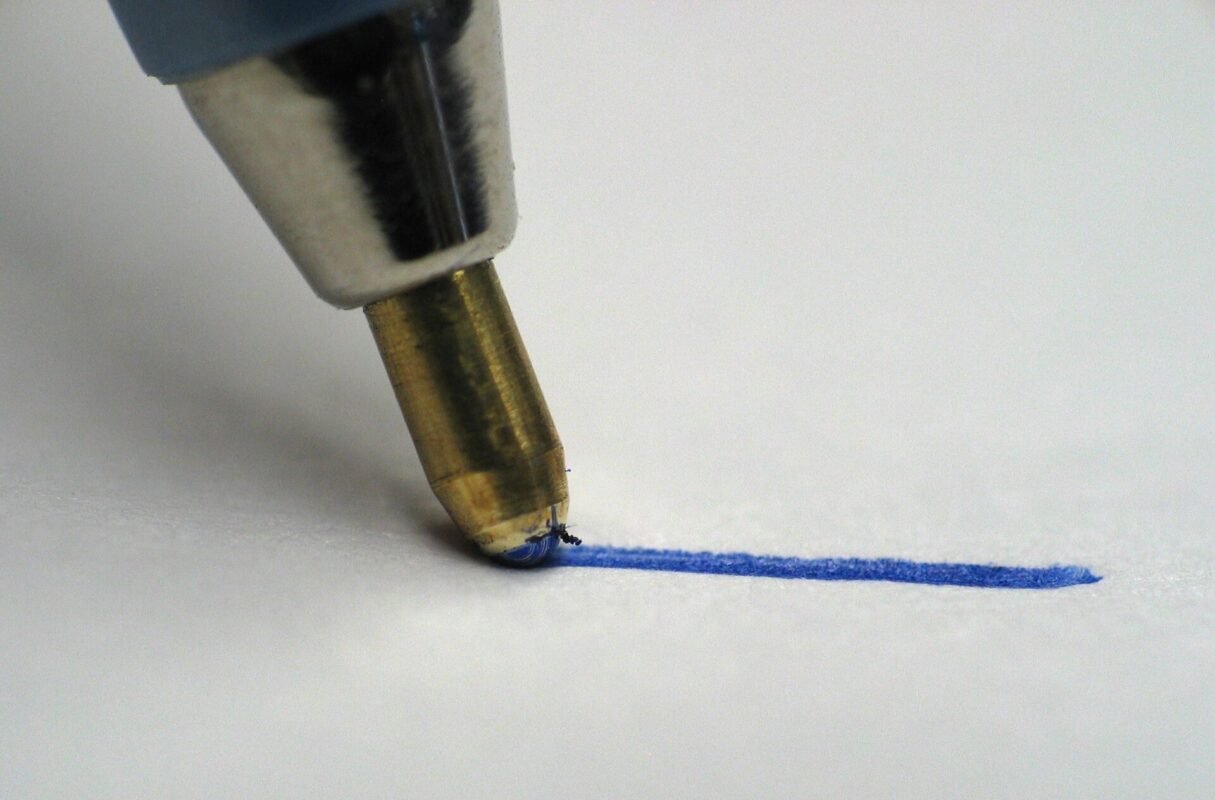
A ballpoint, gel or rollerball refill looks like a simple tube, but it is a precise little machine. These are its main parts.
The tube (reservoir)
The tube holds the ink. It can be plastic, which is light and economical and allows you to see the ink level if transparent, or metal, which is stronger, protects the ink and is common in premium and standard-format refills. Its length and diameter decide which pens it fits and how much ink it holds.
The tip (point)
The tip is the precision-machined cone at the writing end. It holds the ball in a socket with just enough clearance for the ball to rotate freely and carry a thin film of ink, but not enough for ink to leak. Tips are usually made of brass, nickel silver or stainless steel. The accuracy of this tiny part is one of the biggest factors in how smoothly a refill writes.
The ball
The ball is the part that touches the paper. It is usually tungsten carbide or stainless steel and comes in diameters such as 0.5 mm, 0.7 mm or 1.0 mm. Tungsten carbide is very hard and wear-resistant, and its slightly textured surface helps it pick up and carry ink consistently. The ball size sets the width of the line.
The ink
The ink determines most of what you feel when writing: smoothness, drying time, colour intensity and how long the refill lasts. Ballpoint refills use thick, oil-based paste; low-viscosity refills use a thinner oil-based ink; gel refills use a water-based gel; rollerball refills use liquid ink. Each is explained in the next section.
The follower
Many refills, especially gel and low-viscosity ones, have a clear, grease-like plug behind the ink called a follower. It moves down the tube as ink is used, keeping air out, preventing ink from flowing backwards and reducing the risk of leaks when the pen is held upside down or carried in a pocket.
The end plug and vent
At the back of the refill, an end plug or fitting holds the refill in the pen mechanism. Small vents may let air enter the tube as ink flows out so that a vacuum does not form. In click pens, the end of the refill sits against the mechanism; its shape is part of what makes a refill fit a specific pen.
The protective cap or wax seal
New refills often come with a small plastic cap or a dab of wax on the tip to keep the ink from drying out in storage. It must be removed before use; forgetting to do so is a common reason a brand-new refill “won’t write”.
Who this guide is for
This guide is written for anyone who uses or buys pens and wants them to keep writing well:
- Everyday writers who want to know which refill to buy when their favourite pen runs dry.
- Students and parents preparing for exams and a year of note-taking.
- Office managers and admin teams who stock stationery for many people.
- Procurement and purchase teams writing specifications for schools, hospitals, banks and government offices.
- Corporate gifting and marketing teams who want branded pens to stay in use for as long as possible.
- Retailers and distributors who need to stock the right refills and answer customer questions.
- Fountain pen beginners who are confused by cartridges and converters.
If you only need a quick answer, use the at-a-glance table above, the identification steps and the FAQ near the end. If you want to understand why refills behave the way they do, read the anatomy, ink and tip sections in order.
Five things to remember
- Format first: a refill must match the pen’s length, diameter, tip and end shape. The name alone is not enough.
- Ink decides the feel: ballpoint for long life and quick drying, low-viscosity for smoothness, gel for bold colour, liquid for the richest line.
- Tip decides the line: fine for neat small writing, medium for everyday, broad for smooth signatures.
- Freshness matters: store refills cool and capped and use older stock first.
- Refilling saves money and waste: a good pen body can last for years if refills are easy to get.
How refills work
Ballpoint, gel and rollerball refills
All three use the same principle. The ball sits in its socket at the end of the tip, with ink in contact with its upper surface. As you write, friction with the paper rotates the ball. Its upper surface picks up a thin film of ink from inside the tip and its lower surface deposits that ink on the paper. When you stop, the ball sits back in its socket and acts like a seal.
The ink’s thickness, or viscosity, decides how much ink flows and how it behaves on paper. Thick ballpoint paste moves only when the ball turns, which is why ballpoints rarely leak and last a long time. Gel ink thins out as the ball turns and thickens again on paper, giving a bold, smooth line. Liquid rollerball ink flows very freely and soaks slightly into the paper, giving a rich, wet line.
Why refills sometimes skip
Skipping happens when the ball fails to pick up or deliver ink continuously. Common causes include dried ink or dirt at the tip, greasy or glossy paper that the ball slides over without rotating, writing at a very low angle, air bubbles in the ink column, very cold temperatures that thicken the ink, and poor tolerances in the tip. A well-made refill on suitable paper should write evenly from the first stroke.
Fountain pen cartridges and converters
Fountain pens work differently. A cartridge or converter holds liquid ink. When it is pushed onto the pen’s feed, a small spike or tube pierces or opens it, and ink flows into the feed. From there, capillary action draws ink down the slit in the nib to the paper, while air bubbles back into the reservoir. A cartridge is sealed and disposable; a converter is a small refillable reservoir with a piston or squeeze mechanism that lets you draw ink from a bottle.
Refill ink types explained
Classic oil-based ballpoint ink
The traditional ballpoint ink is a thick paste made of dyes or pigments dissolved or dispersed in oil-based solvents and resins. It dries almost instantly, resists smudging and water better than many water-based inks, writes on almost any paper including carbonless forms, and lasts a long time per refill. The trade-off is that it needs a little more pressure and gives a slightly paler line than gel or liquid ink.
Low-viscosity (hybrid) ink
Low-viscosity ballpoint inks are thinner versions of oil-based ink. They glide much more smoothly, give a darker line and still dry quickly. Many modern “smooth writing” refills are of this type. The best of them feel almost like gel while keeping the practical advantages of ballpoint ink.
Gel ink
Gel ink is water-based and thickened with special agents so it behaves like a gel at rest and flows freely when the ball rotates. It often contains pigments for opaque, vivid colour, including metallic and white inks. Gel refills write very smoothly with little pressure but use ink faster and take a little longer to dry.
Liquid (rollerball) ink
Liquid ink is thin and water-based, similar to fountain pen ink. It gives the smoothest, richest line but uses ink quickly, can bleed on thin paper and dries out if the refill is left uncapped. Liquid-ink refills are almost always used in capped pens.
Pressurised ink
Pressurised refills hold a thick ink sealed in a cartridge with gas pressure behind it, so ink is pushed to the ball at any angle. They write upside down, on wet surfaces and in cold conditions, which suits field and outdoor use.
Erasable ink
Erasable gel refills use a heat-sensitive ink that becomes invisible when warmed by friction from an eraser. They are useful for planners and students but should never be used on documents that must be permanent.
Documentary inks
Some refills are made to meet ISO 12757-2, the standard for ball point pens and refills for “documentary use”. This standard looks at whether writing stays legible on documents that may be needed as evidence, including resistance to treatments such as bleaching. If you sign contracts, cheques or legal documents, a documentary-grade refill is a sensible choice.

How refills are made
Making a refill that writes smoothly every time takes precision engineering. While methods vary between manufacturers, the main stages are similar.
- Tube production: plastic tubes are extruded and cut to length; metal tubes are formed and finished.
- Tip machining: tips are machined from metal wire or rod to very fine tolerances, including the socket that will hold the ball.
- Ball insertion: the ball is placed into the socket and the tip is closed around it, leaving just enough freedom for the ball to rotate.
- Ink preparation: ink is mixed to a precise formulation for colour, viscosity and drying behaviour.
- Filling: ink is filled into the tube, often followed by the follower.
- Assembly: the tip is fitted to the tube and the end plug is added.
- Air removal: refills are commonly spun or processed so that ink settles firmly against the tip without air gaps.
- Testing: samples are tested for start-up, line consistency, writing length and leakage.
- Tip protection: a cap or seal is applied and refills are packed.
Each step affects the final writing experience. Small differences in tip tolerance or ink formulation are the reason two refills that look the same can write very differently.

DYNA and refill manufacturing
Refills are part of DYNA’s history. In the late 1970s, Harshad Kumar Mehta, an IIT Delhi engineer and son of our founder, studied refill technology in Switzerland, and DYNA went on to build its own manufacturing systems for ballpoint pens and refills. That engineering focus on the refill is why we pay close attention to refill quality and compatibility in every pen we make. Read more in Our Story & Legacy and Our Journey, and see The Evolution of Pen Manufacturing in India.
Refill colours and speciality refills
Standard colours
Blue, black, red and green cover the vast majority of refill sales. Blue is easy to distinguish from printed black text, which is one reason it is often required for signatures on forms. Black photocopies and scans most cleanly. Red is traditional for corrections and marking, and green is used for specific purposes in some organisations.
Colour consistency
Not every “blue” is the same. Ballpoint blues tend to be slightly muted, gel blues are brighter, and liquid-ink blues are richer. If a team needs matching colours on shared documents, standardise on one refill.
Fashion and planner colours
Gel refills come in a wide range of colours, including pastels, neons and metallics, which are popular for journals, planners, greeting cards and colour-coded notes. Multi-pens with several D1 refills make it easy to carry a small palette in one barrel.
White and opaque inks
Pigmented gel inks can be opaque enough to write in white or metallic colours on dark paper, useful for scrapbooking, labelling and craft work.
Security inks
Some refills are designed to make tampering with documents harder, for example by bonding pigment into the paper fibres so the writing resists washing or chemical alteration. These are typically marketed for cheques and legal documents and often refer to the documentary-use parts of ISO standards.
Quick-dry inks
Fast-drying gel and hybrid inks have been developed to reduce smudging, which helps left-handed writers and anyone who writes quickly on coated paper.
Choosing refills for schools and students
Students write more by hand than almost anyone else, so the refill matters. A few practical points help parents, teachers and school buyers.
Younger children
Children learning to write with pens usually benefit from a smooth, medium refill that does not need much pressure. Clear barrels or transparent refills help them see when ink is running low.
Middle and senior school
As note-taking speeds up, many students prefer smooth gel or low-viscosity refills. A fine tip keeps small handwriting neat in notebooks. For exams, they should use a refill they already know well.
Board exams
Students should take at least two identical pens with fresh refills into the exam, plus a spare refill if allowed. They should test each pen before the day, check that the ink does not show badly through the answer sheet and follow the colour rules set by the board or school.
Colleges
College students often carry one good refillable pen and a few refills rather than many cheap pens. It is a good time to introduce refillable habits that save money over years of study.
School buyers
For schools buying pens for students or staff, standardising on one or two refillable models simplifies supply. Buying refills in bulk at the same time ensures students can replace refills cheaply during the year. Branded pens with the school name are popular for events and prize days; see Pen Branding Methods Explained and our customisation options.
How refills interact with paper
A refill and the paper it writes on work as a pair.
- Smooth office paper: works well with all refill types.
- Thin paper: ballpoint ink shows through least; liquid ink may bleed or show through.
- Coated or glossy paper: ballpoints can skip; gel ink may take longer to dry. Test first.
- Recycled paper: often slightly more absorbent and textured; medium tips feel smoother than very fine ones.
- Carbonless and carbon copies: classic ballpoint with firm pressure works best.
- Notebooks and diaries: gel and liquid ink look their best on good-quality paper; see our diaries and notebooks.
Refill formats in detail
Refill formats are defined by length, diameter, tip shape and end fitting. Some are international standards used by many pen makers; others are specific to one brand or one pen design. Knowing the main families saves a lot of trial and error.
Parker-style G2 (ISO G2) refills
The most widely shared metal refill format is the one originally created by Parker and now standardised by ISO, commonly called the Parker-style G2 or ISO G2 refill. It is used by many different pen brands, which makes it one of the easiest refills to replace. It is roughly 98 mm long and about 5.8 mm in diameter on the main body, with a metal tube and a distinctive tip. Ballpoint is the most common version, but gel and rollerball-style ink versions are also made in this format, which lets you change the writing feel of a pen without changing the pen.

Do not confuse “G2” names. The Parker-style G2 refill is completely different from the refill used in the popular Pilot G2 gel pen. They have different shapes and lengths and are not interchangeable. When buying, check the dimensions or the list of compatible pens, not just the name.
D1 mini refills
D1 refills are very slim and short, around 67 mm long and about 2.3 mm in diameter. They are used in multi-pens that hold several colours in one barrel, in mini pens and in slim pens. Because they are so thin, they hold much less ink than a full-size refill, but they come in ballpoint, gel and hybrid inks and in many colours from different makers.
Cross-style refills
Some slim metal pens use a slender refill style associated with Cross pens, often with a threaded or push-fit end. They look slim like D1 refills but are much longer, so the two are not interchangeable. Pressurised refills are also made in this style for some pens.
Japanese-style metal and plastic refills
Many Japanese pen brands use their own refill designs for gel, hybrid and ballpoint pens, often with plastic tubes and brand-specific lengths. These usually fit only the same brand’s pens, although some adapters exist.
Everyday plastic ballpoint refills
In India, a large share of pens use plastic ballpoint refills of various lengths and diameters. Some are standardised across many local makers; others are specific to a pen design. Everyday refillable plastic pens and “use-and-throw” pens both use this type. When replacing one, compare the old refill side by side with the new one for length, tip shape and the shape of the back end, because a few millimetres can make the difference between a pen that clicks properly and one that does not.

Gel refills
Gel refills come in plastic and metal formats. Plastic gel refills often have transparent tubes so you can see the ink level and a follower behind the ink. Some metal gel refills are made in the Parker-style G2 format, which lets metal pens that normally take ballpoint refills write with gel ink instead.
Rollerball refills
Capped rollerball pens use liquid-ink refills that are usually wider and shorter than ballpoint refills. A widely used European rollerball refill format fits many capped pens from different brands, while others are proprietary. Rollerball refills generally cannot be used in click pens because the liquid ink would dry without a sealed cap.
Pressurised refills
Pressurised refills are made in several common formats so they can replace standard refills in compatible pens. This lets you upgrade an ordinary pen for writing upside down, in the cold or on damp paper.
Fountain pen cartridges
Many European and Japanese fountain pen makers use a shared pattern known as the international standard cartridge. It comes in two sizes: a short cartridge of about 38 mm and a long cartridge of about 73 mm. Pens that accept the short size often accept the long one too if the barrel is long enough, or can hold two short cartridges, one as a spare. Several well-known brands use their own proprietary cartridges instead, so check your pen’s manual or ask the seller.

Fountain pen converters
A converter replaces a cartridge with a small refillable reservoir. You dip the nib into a bottle of ink and turn a piston or squeeze a sac to draw ink up. Converters open up the huge world of bottled inks and are cheaper per page than cartridges. International converters fit pens that take international cartridges; proprietary pens need their own brand’s converter.
Proprietary refills
Some pens use refills designed specifically for them. These can be excellent, but replacements must come from the same brand or a compatible maker. Before buying a pen, especially for long-term or bulk use, it is worth checking whether its refill is a standard format or a proprietary one.
ISO standards for refills
International standards help make refills predictable and, in some cases, interchangeable. You do not need to read the standards to buy a good refill, but knowing what they cover helps when you compare products or write a tender.
ISO 12757: ball point pens and refills
ISO 12757 is the main international standard for ballpoint pens and their refills. Part 1 covers general use: it sets out requirements and test methods for things such as writing performance, and it specifies the dimensions of interchangeable refill types so pens and refills from different makers can work together. Part 2 covers documentary use, adding requirements for writing that must stay legible on important documents. When a supplier says a refill “meets ISO 12757”, ask which part and which type.
ISO 14145: roller ball pens and refills
ISO 14145 is the equivalent standard for rollerball pens and refills, again with a general-use part and a documentary-use part. It is relevant if you buy liquid-ink pens for offices where signatures and records matter.
ISO 27668: gel ink ball pens and refills
ISO 27668 covers gel ink ball pens and refills, including requirements for general use and for documentary use. It reflects how widely gel pens are now used in schools and offices.
ISO 12756: vocabulary
ISO 12756 defines the vocabulary used for drawing and writing instruments, so that terms such as “refill”, “ball point” and “writing length” mean the same thing in different countries and documents.
Why standards matter to buyers
- Interchangeability: standard refill types fit pens from many brands, so users are not locked into one supplier.
- Comparable claims: tests such as writing length are carried out in defined ways, making comparisons fairer.
- Document security: documentary-use parts give a clear benchmark for inks used on contracts, cheques and records.
- Tenders: referencing a standard in a purchase specification is clearer than “good quality refill”.
Inside the tip: why precision matters

The ballpoint tip is one of the most precise mass-produced parts most people ever handle. Its job is contradictory: hold a ball tightly enough that it never falls out and ink never leaks, but loosely enough that it rotates with almost no resistance and carries a perfectly even film of ink.
The socket
Inside the tip, the ball sits in a socket with small channels that guide ink from the tube to the back of the ball. The shape of these channels controls how much ink reaches the ball. Too little and the line is pale or skips; too much and the line blobs.
The rim
The front edge of the tip is rolled or pressed inward around the ball. This rim holds the ball in place and leaves a precise amount of the ball exposed. If the rim is uneven, the pen may scratch or write unevenly depending on the angle.
Ball material and finish
Tungsten carbide balls are very hard, so they keep their shape and surface texture over the life of the refill. Their microscopically rough surface helps them grip the paper and pick up ink. Stainless steel balls are also used, particularly in some lower-cost refills.
Tip material
Brass is common because it machines well; nickel silver and stainless steel are harder and more corrosion-resistant, which suits water-based gel and liquid inks. Gel refills often use stainless steel tips for this reason.
Needle and cone tips
A cone tip is the classic ballpoint shape: robust and comfortable. A needle tip is a long, thin tube that lets you see exactly where the line will go, which many people like for fine writing and drawing tables. Needle tips are common on fine gel refills.
Why two similar refills feel different
Small variations in socket shape, rim finish, ball size tolerance and ink formulation add up. That is why it is worth testing refills before buying in bulk, and why a trusted manufacturer’s consistency is valuable: each refill in a box of a thousand should write like the first.
How to identify the refill your pen needs
If you are not sure which refill your pen takes, a few minutes with the old refill and a ruler usually answers the question.
1. Remove the old refill
Unscrew or pull apart the pen as described in the next section and take out the refill. Keep any spring, as it may stay in the barrel or come out with the refill.
2. Look for markings
Many refills have the maker’s name, model, colour or tip size printed on the tube. Search for that code; it is often the quickest route to an exact match.
3. Measure length and diameter
Measure the overall length in millimetres, and the diameter of the main tube. Compare with common formats: about 98 mm long and 5.8 mm wide suggests a Parker-style G2 refill; about 67 mm long and 2.3 mm wide suggests a D1 mini refill.
4. Check the tip shape
Note whether the tip is a short cone, a long cone or a needle point, and whether it is metal or plastic. Click pens need the tip to pass through the opening at the front, so the shape must match.
5. Check the back end
Look at the end of the refill: is it flat, rounded, stepped, threaded or fitted with a plastic plug? In click and twist pens, this end engages the mechanism, so it must match.
6. Note the ink type
Was the original refill ballpoint, gel or liquid ink? You can often change ink type within the same format, but rollerball liquid-ink refills generally need a capped pen.
7. Compare side by side
When buying, hold the new refill next to the old one. Small differences in length or end shape are easiest to see this way.

How to replace a refill, step by step
Click (retractable) pens
- Retract the tip.
- Unscrew the pen at the joint, usually near the middle or just above the grip. Some pens pull apart instead.
- Remove the old refill and keep the spring.
- Remove the protective cap or wax from the new refill’s tip.
- Slide the spring onto the new refill from the tip end, so it sits against the shoulder near the tip.
- Insert the refill into the barrel and screw the pen back together.
- Click a few times to check the action, then scribble on scrap paper to start the ink.
Twist pens
- Twist to retract the tip.
- Unscrew the pen, often at the front section.
- Pull out the old refill; in some designs it unscrews from the mechanism.
- Fit the new refill, fully seated or screwed in.
- Reassemble and twist to check that the tip extends fully and retracts.
Capped pens
- Remove the cap and unscrew the front section from the barrel.
- Pull the old refill out of the front section.
- Push the new refill in firmly.
- Screw the barrel back on.
Multi-pens
- Unscrew the front section or open the barrel as the design requires.
- Pull out the refill you want to replace; they often lift out of individual slots.
- Insert the new D1 or compatible refill into the same slot.
- Reassemble and test each colour.
Fountain pens with cartridges
- Unscrew the barrel from the grip section.
- Pull out the empty cartridge.
- Push a new cartridge firmly onto the feed until you feel it seat; the seal is pierced as you push.
- Hold the pen nib-down for a moment or gently squeeze the cartridge to help ink reach the nib.
- Screw the barrel back on and write on scrap paper.
Fountain pens with converters
- Fit the converter in place of a cartridge.
- Dip the whole nib into a bottle of fountain pen ink.
- Turn or squeeze the converter to draw ink up.
- Wipe the nib and section with tissue, and turn the converter slightly to release a drop back into the bottle so air space remains.
If a new refill will not write
- Check for a cap or wax seal on the tip and remove it.
- Scribble gently in small circles on scrap paper to get the ball rolling.
- Warm the tip slightly in your hand if the room is cold.
- Check the fit: if the tip does not extend fully through the pen’s opening, the refill may be too short or the spring may be missing.
- Check the paper: greasy, glossy or dusty paper can stop a ball from rolling.
- For fountain pens: make sure the cartridge has been pushed on fully so the seal is broken, and give it time to saturate the feed.
- Try another refill from the same pack; occasionally a single refill is faulty.
Refill or replace the pen?
Refilling is usually the better choice, but not always. A simple decision guide:
| Situation | Best choice | Reason |
|---|---|---|
| Metal or premium pen in good condition | Refill | The body is the valuable part and lasts for years |
| Refillable plastic pen in daily use | Refill | Low cost, less waste, familiar pen |
| Disposable pen | Replace (and switch to refillable next time) | Designed as one unit |
| Mechanism broken or clip snapped | Replace the pen | A new refill will not fix the body |
| Gift pen with branding | Refill | Keeps the brand in the user’s hand |
| Pen with hard-to-find proprietary refill | Refill if available; otherwise replace with a standard-format pen | Avoid future supply problems |
| Fountain pen | Refill (cartridge or converter) | Fountain pens are built to be refilled for decades |
Understanding cost per page
The price on the pack is only part of the story. A more useful measure is cost per page or cost per month of use.
- Note the price of one refill or one pen.
- Estimate usage: how many pages or how many weeks a refill lasts for a typical user (track a few users if possible).
- Divide price by pages (or weeks) to get cost per page (or per week).
- Compare options: a refillable pen plus refills versus buying new pens each time.
Because refills are a small fraction of the cost of a good pen body, refillable systems tend to win over time, particularly for metal pens. The calculation also helps when deciding between ink types: a gel refill may cost a similar amount to a ballpoint refill but run out sooner, so its cost per page is higher, which may still be worthwhile if users prefer it.
Tips for retailers and stationery shops
- Stock the common formats: customers most often ask for refills for everyday plastic pens, popular metal pens and multi-pens.
- Label clearly: show length, colour, tip size and the pens each refill fits.
- Keep a measuring card at the counter so customers can match their old refill.
- Rotate stock so older refills sell first, and keep them out of sunlight and heat.
- Suggest upgrades: a customer replacing a refill may enjoy a smoother low-viscosity or gel option in the same format.
- Bundle pens with spare refills for students before exams.
Interested in stocking DYNA pens and refills? See Become a Partner or contact our team on WhatsApp.
Writing a refill specification for tenders
Institutions buying refills or refillable pens in large quantities often write a short specification. Clear wording prevents surprises at delivery.
- Refill type and format: for example ballpoint, Parker-style G2 metal refill, or a plastic refill compatible with a named pen model.
- Ink: oil-based ballpoint, low-viscosity, gel or liquid; colour.
- Tip size: for example 0.7 mm.
- Standard: ISO 12757-1 for general use, or ISO 12757-2 where documents need permanence (and the equivalent standards for rollerball and gel).
- Packaging: tip caps, pack size, labelling.
- Shelf life and storage: manufacture date on cartons; supplier storage conditions.
- Samples: pre-shipment samples for approval.
- Acceptance testing: how many refills will be tested on delivery and what counts as a pass.
For a full procurement checklist, see our bulk buying guide.
How long does a refill last?
Refill life is usually described as “writing length”: the total length of line a refill can draw before running out. Manufacturers test it by drawing continuous lines on paper with a machine under standard conditions. It is a useful comparison between refills, but real-life writing varies with how hard you press, how large you write, the paper and the temperature.
What affects writing length
- Ink volume: longer and wider refills hold more ink. Slim D1 refills hold far less than full-size refills.
- Ink type: classic ballpoint ink lays down a very thin film and generally lasts longest; low-viscosity ink lays down a little more; gel and liquid inks use the most.
- Tip size: a broader ball lays down more ink per word than a fine one.
- Handwriting: large handwriting, heavy pressure and lots of underlining use more ink.
- Storage and age: ink that has partly dried in an old refill reduces usable life.
Estimating your own usage
The simplest way to understand refill life for your situation is to note the date you start a new refill and the date it runs out. Do this for a few refills of different types and you will quickly see which suits your writing best. Organisations can do the same with a small group of users before ordering refills in bulk. For a broader view of pen longevity, see How Long Does a Dyna Pen Last?
Signs a refill is nearly empty
- The line becomes paler or starts to skip despite clean paper.
- In transparent refills, the ink column is near the tip.
- The pen writes only when held at certain angles.
Keep a spare refill in your desk or bag so you are never caught out mid-meeting or mid-exam.
Storing refills properly
Refills have a long shelf life when stored well, but ink is a chemical product that changes slowly over time, especially in heat.
- Keep them cool and dry, away from direct sunlight, radiators, car dashboards and hot storerooms.
- Leave tip caps or seals on until use.
- Store gel and liquid-ink refills tip-down or flat, as recommended by the maker, to keep ink at the tip.
- Use older stock first. Rotate stock in offices and shops so refills do not sit for years.
- Keep fountain pen cartridges sealed and avoid freezing temperatures.
Why refilling is worth it
Lower cost per page
The body of a pen, especially a metal pen, often costs much more than its refill. Replacing only the refill keeps a good pen in use for years at a fraction of the cost of buying new pens.
Less waste
Every refill you use instead of a whole new pen saves the plastic or metal of the body, the clip and the mechanism. For organisations that buy thousands of pens a year, switching to refillable pens and buying refills separately can significantly reduce waste. Read Benefits of Using Recyclable Pens in the Workplace and Dyna Eco Series: Where Sustainability Meets Style.
Familiarity
People get attached to a pen that fits their hand. Refilling lets them keep it.
Upgrading the writing feel
Changing the refill is the easiest way to change how a pen writes. A metal pen that takes Parker-style G2 refills, for example, can switch from classic ballpoint to a smoother low-viscosity or gel refill in the same format.

How to choose the right refill
By how you write
| If you… | Choose | Why |
|---|---|---|
| Fill forms, carbon copies or registers | Classic ballpoint | Quick-drying, presses through copies, long life |
| Want smoothness without smudging | Low-viscosity (hybrid) ballpoint | Glides easily, dries fast |
| Want bold, dark notes | Gel | Vivid, smooth, easy to read |
| Sign documents and letters | Rollerball or documentary-grade ballpoint/gel | Rich line or archival permanence |
| Are left-handed | Ballpoint or hybrid, fine tip | Fast drying reduces smearing |
| Write small | 0.5 mm or finer | Neater, clearer letters |
| Write large or press lightly | 0.7–1.0 mm | Smoother, bolder line |
| Work outdoors or in the cold | Pressurised | Writes at any angle and in difficult conditions |
| Want many colours in one pen | D1 multi-pen refills | Several colours in one barrel |
By ink colour
Blue and black cover almost all needs. Blue is common in Indian schools, exams and offices; black is preferred for formal and scanned documents. Red and green are used for marking and specific official purposes. Check any rules your exam board, bank or organisation applies.
By tip size
Medium (around 0.7 mm) is the most common general-purpose size for ballpoints. Fine (around 0.5 mm) is popular for gel pens and small handwriting. Broad (1.0 mm) feels smoothest and suits signatures. Our guide to pen tip and nib sizes covers this in depth; see also Best Pen for Good Handwriting.
By permanence
For legal documents, cheques and records, choose a refill designed for documentary use and avoid erasable or water-soluble inks.
Refills for different kinds of pens
Metal pens
Many metal twist and click pens are designed around standard metal refills such as the Parker-style G2 format, which makes them easy to refill for years. Premium metal pens may use their maker’s own refill. When you buy metal pens, especially for gifting, it is worth choosing models with readily available refills so recipients can keep using them. See our premium metal pens and regular metal pens.
Plastic pens
Plastic pens range from disposable designs, where the refill is effectively part of the pen, to refillable designs that take a separate plastic refill. For offices and institutions, refillable plastic pens offer a good balance of low cost and reduced waste. Our plastic pens, including Elite and Aurora, are built around reliable ballpoint refills.
Liquid-ink and rollerball pens
Liquid-ink pens such as our Aero Flow pens are designed for smooth, free-flowing ink. Keep them capped when not in use so the tip does not dry out.
Fountain pens
Fountain pens use cartridges, converters or built-in fillers. Cartridges are convenient and clean; converters give access to bottled ink. Our Black Tie fountain pen is a gift-ready example. For a full beginner’s introduction, see Fountain Pens for Beginners.
Multi-pens
Multi-pens hold two to four slim refills, usually D1 format, in one barrel. They are practical for teachers, accountants and editors who switch between colours. Replace each colour as it runs out.
Eco pens
Many eco-friendly pens use standard refills, so the recycled or plant-based body can be reused. When choosing eco pens, a refillable design is often the biggest environmental benefit. See our eco-friendly pens and Eco Klick vs Eco Polo.
Refills for offices, schools and institutions
For organisations, refills are a quiet way to save money and reduce waste while keeping pens consistent.
Standardise on a few pen models
If everyone uses one or two refillable pen models, you only need to stock one or two refill types. Choose models with standard, widely available refills.
Buy refills in bulk
Refills are compact and inexpensive to store. Buying them in bulk alongside pens keeps a steady supply and reduces the temptation to buy whatever pen is available when one runs out.
Make refills easy to get
Keep refills in a known place, such as the stationery cupboard or front desk, and make it easy for staff and students to swap them. People are much more likely to refill than replace when refills are close at hand.
Track consumption
Note how many refills each department uses per month. This helps you plan reorders and spot unusual usage.
Test before switching
If you change to a new refill, test a small batch with real users first. Staff who sign many documents, for example, may prefer a smoother low-viscosity refill, while front desks may need the long life of a classic ballpoint.
For more on bulk purchasing, see our guide to buying pens in bulk.
Common refill compatibility pitfalls
- Same name, different refill. “G2” can mean the Parker-style ISO refill or a completely different gel refill. Always check dimensions.
- Almost the right length. A refill a few millimetres too long may stop a click pen from retracting; too short may stop the tip from extending fully.
- Different end fittings. Twist mechanisms in particular may need a specific end shape or thread.
- Wrong ink for the pen. Liquid-ink rollerball refills will dry out in a click pen without a cap.
- Missing spring. Springs sometimes fall out unnoticed when the old refill is removed.
- Proprietary cartridges. Not all fountain pens take international cartridges.
- Assuming all plastic refills are the same. Local plastic refills vary widely; compare side by side.
Refill troubleshooting
| Problem | Likely cause | What to try |
|---|---|---|
| New refill will not start | Tip cap or wax left on; air at the tip | Remove the seal; scribble in circles; warm the tip |
| Tip does not come out fully | Refill too short; spring missing | Check length against old refill; refit spring |
| Pen will not retract | Refill too long; wrong end shape | Use the correct format |
| Line skips | Greasy or glossy paper; dirt on ball; cold | Clean the tip; try plain paper; warm the pen |
| Ink blobs at start of lines | Ink collecting around the ball | Wipe the tip; try a different ink formulation |
| Gel refill fades mid-word | Air bubble or ink separation | Tap the refill tip-down; store tip-down |
| Ink leaks into the pen | Heat; damaged tip; pressure changes | Replace refill; avoid hot cars and keep upright on flights |
| Fountain cartridge not feeding | Not pushed on fully; dried nib | Push firmly; flush the nib with water |
| Converter will not fill | Nib not fully submerged; air leak | Submerge the whole nib; reseat the converter |
| Refill runs out very quickly | Slim refill; broad tip; gel or liquid ink | Choose a larger format or a ballpoint ink |
Refill myths
“All refills are the same inside.”
They are not. Ink formulation, tip machining and ball material vary widely, which is why two refills of the same size can write very differently.
“A finer tip always writes better.”
Finer tips write neater lines but feel scratchier, because a small ball has less contact with the paper. Many people find a medium tip more comfortable.
“Gel refills are always better than ballpoint.”
Gel refills are smoother and bolder, but ballpoint refills dry faster, last longer, travel better and work on carbon copies. The best choice depends on the job.
“You can put any refill in any pen.”
Only refills of the right format fit and function properly. Adapters exist for some combinations, but matching the format is always the safest choice.
“Refilling is too much trouble.”
Most refills take under a minute to change. With refills stocked nearby, refilling is quicker than finding a new pen.
“Old refills are as good as new.”
Ink can slowly change in old refills, especially in heat. Fresh, well-stored refills write best.
Refills and the environment
A refill contains far less material than a complete pen. Every time a refill replaces a new pen, the body, clip and mechanism stay in use. Choosing durable, refillable pens, buying refills in sensible quantities and storing them properly so none dry out unused are simple ways to reduce waste. Metal and well-made plastic pen bodies can last for years with regular refills, which makes them a sustainable choice for individuals and organisations alike. See From Waste to Write: How Recycled Pens Are Redefining Sustainability and How Our Eco Pens Help Reduce Your Brand’s Carbon Footprint.
A short history of the refill
The idea of a replaceable ink unit grew up with the modern pen. Early fountain pens were filled directly from ink bottles, and cartridges later made refilling cleaner and quicker. When László Bíró patented the modern ballpoint in 1938, the combination of a ball tip and thick ink inside a tube created the template for the ballpoint refill that is still used today. As ballpoints spread through mass production after the Second World War, replaceable refills allowed pen bodies to be reused, while cheaper disposable designs made pens available to everyone.
Later decades brought new ink types into the same basic refill: water-based liquid ink for rollerballs from the 1960s, gel ink from the 1980s, low-viscosity ballpoint inks and erasable inks. Standardisation through ISO, including standards for ballpoint and rollerball refills and their general and documentary uses, helped make some formats interchangeable across brands. For the Indian side of this story, read The Evolution of Pen Manufacturing in India, and for the bigger picture see the timeline in Types of Pens.
Choosing refills for special situations
Exams
For exams, reliability matters more than anything else. Use a refill you have already tested over several pages, check it has plenty of ink, and carry a spare pen with an identical refill. Students who write quickly often prefer gel or low-viscosity refills for comfort; those writing on thin answer sheets may prefer ballpoint ink, which shows through less. See The Best Pens for Exams.
Signing documents
Choose a refill with permanent, documentary-grade ink, in the colour your organisation requires. A broad ballpoint, gel or rollerball refill gives a confident signature. Never use erasable ink.
Doctors and healthcare
Prescriptions, charts and forms call for a quick-drying, reliable ballpoint refill that writes on all kinds of paper, including duplicate forms. Pens are often clipped to coats and used standing up, so a refill that starts instantly is valuable.
Accounts and ledgers
Fine-tip ballpoint or hybrid refills keep figures neat in small columns, and multi-pens with red, black and blue refills make corrections easy.
Travel and flights
Ballpoint refills are the safest choice on flights because their thick ink resists pressure changes. Gel refills are usually fine; liquid-ink and fountain pens need more care.
Cold or outdoor work
Pressurised refills keep writing in cold weather, on damp paper and at awkward angles, which suits surveyors, engineers, drivers and field staff.
Journalling and creative work
Fine gel refills in many colours, and fountain pens with bottled ink, give the most expressive results for journals and planners.
Banks, counters and reception desks
Pens at counters are used by many different people, often on deposit slips, registers and duplicate forms. A durable refillable pen with a long-life classic ballpoint refill in blue or black is the practical choice. Keep a box of matching refills at each counter so staff can swap them the moment a pen runs pale, and check counter pens weekly. Pens that are chained or tethered at counters are especially worth refilling rather than replacing.
Corporate gifting
For gift pens, choose refills that write smoothly from the first stroke, and make sure replacements are easy to find so the gift keeps being used. A smooth low-viscosity or gel refill in a well-made metal body leaves a strong impression. See Corporate Gifting Pens and Choosing the Right Pen for Executive Gifting.
Buying refills: what to check
- Format and dimensions match your pen.
- Ink type suits how and where you write.
- Tip size suits your handwriting.
- Colour meets any rules you must follow.
- Freshness: buy from a supplier with good stock turnover.
- Packaging: tips should be capped or sealed.
- Quantity: enough for regular use, but not so many that they sit for years.
If you need refills for a pen you bought from DYNA, or you want pens designed around easily available refills, our team can help you choose.
Refills in India: what is different
India is one of the world’s largest markets for pens, and refills play a bigger role here than in many countries. A few local patterns are worth knowing.
Refilling is a habit
Many Indian students and office workers grew up buying refills rather than new pens. Neighbourhood stationery shops keep refills for popular pens behind the counter, often sold singly. This habit makes refillable pens a natural fit for Indian schools, colleges and offices.
Blue ink dominates
Blue is the default colour in most schools and many offices and exam halls, so blue refills account for a large share of demand. Black is common for formal documents, and red and green have specific uses in marking and some official work.
Board exams and answer sheets
Long exams on thin answer sheets put refills to a real test. Students often prefer smooth refills for speed, but ink that shows through thin paper can make answers harder to read. Testing a refill on the paper you will use, and carrying a spare, is the best precaution.
Heat and humidity
Summer temperatures in much of India are high, and refills stored in hot shops, vehicles or warehouses can age faster or leak. Buying from suppliers with good stock turnover and storing refills in a cool place indoors keeps them writing well. Gel and liquid-ink refills are the most sensitive to heat.
Carbon copies and registers
Many Indian businesses, banks and government offices still use carbon copies, duplicate books and handwritten registers. Classic ballpoint refills, which press firmly and dry instantly, are the right choice here.
GST and HSN
Pens and refills are classified under HSN heading 9608. If you buy refills for a business, ask your supplier for a GST invoice with the correct HSN code so you can claim input tax credit where eligible. Rates can change, so confirm the current rate with your supplier or tax adviser. Our bulk buying guide covers GST in more detail.
Looking after refills and pens
A little care helps refills write well to the last line.
- Retract or cap the pen after use, so the tip is protected from dust and drying.
- Do not leave pens in hot places, such as car dashboards or near windows in summer.
- Write on suitable paper. Very glossy or greasy surfaces can clog a ball with residue.
- Wipe the tip occasionally with a soft tissue if ink builds up around the ball.
- Avoid dropping pens tip-first; a hard knock can damage the ball seat and cause skipping or leaks.
- Clean fountain pens with plain water when changing ink colours or every few weeks of use.
- Do not shake gel refills hard; it can introduce air into the ink column.
- Keep spare refills sealed until you need them.
For a complete routine, see Pen Care and Maintenance.
How DYNA approaches refills
Because refill engineering is part of our story, we approach every pen we make from the refill outwards.
Designing pens around reliable refills
The refill decides the writing experience, so we start with it. Pen bodies, mechanisms and grips are designed to hold the refill precisely, so the tip sits steadily and the click or twist action is consistent.
Consistency in large orders
For schools, offices and corporate orders, every pen in a box needs to write like the first one. We focus on consistent ink flow, start-up and line quality across production batches.
Inks for different jobs
Our range covers classic ballpoint pens for forms and daily work, smoother liquid-ink pens such as Aero Flow, and gift-ready fountain, rollerball and ballpoint pens such as the Black Tie rollerball and Black Tie ballpoint.
Refillable designs
Where it suits the product, we prefer refillable designs so pens can keep working for longer, which is better for users and for the environment. Our eco-friendly pens carry that idea further with recycled and sustainable materials.
Help choosing
If you are not sure which refill or pen suits your users, tell us how the pens will be used, who will use them and how many you need. We can suggest options and send samples. You can also browse our full range of writing instruments.

Quick refill checklist
- Identify the format: measure length and diameter, check tip and end shape.
- Choose the ink: ballpoint, low-viscosity, gel, liquid, pressurised or cartridge.
- Choose the tip: fine for small writing, medium for everyday, broad for smoothness and signatures.
- Choose the colour: follow any rules for exams, banks or your organisation.
- Check permanence for documents: look for documentary-use standards.
- Buy fresh: from a supplier with good stock turnover, tips capped.
- Store well: cool, dry, out of sunlight.
- Fit carefully: remove the tip seal, keep the spring, test on scrap paper.
- Keep a spare: in your desk, bag or exam kit.
- Track usage: note how long refills last to plan reorders.
Refill glossary
- Ball
- The tiny sphere at the tip that rotates and transfers ink to paper.
- Ballpoint refill
- A refill using thick, oil-based paste ink and a ball tip.
- Cartridge
- A sealed, disposable ink container for fountain pens.
- Cone tip
- The classic conical ballpoint tip shape.
- Converter
- A refillable reservoir that replaces a cartridge in a fountain pen and draws ink from a bottle.
- D1 refill
- A slim, short refill format used in multi-pens and mini pens.
- Documentary use
- Inks and refills designed so writing stays legible on important documents, covered by parts of ISO standards such as ISO 12757-2.
- End plug
- The fitting at the back of a refill that engages the pen mechanism.
- Erasable ink
- Heat-sensitive ink that becomes invisible when rubbed with a special eraser.
- Follower
- A grease-like plug behind the ink in many refills that prevents leaks and backflow.
- Gel ink
- Water-based ink thickened into a gel that flows when the ball turns.
- International standard cartridge
- A shared fountain pen cartridge pattern in short (about 38 mm) and long (about 73 mm) sizes.
- ISO 12757
- The international standard for ballpoint pens and refills.
- ISO 14145
- The international standard for rollerball pens and refills.
- ISO 27668
- The international standard for gel ink ball pens and refills.
- Low-viscosity ink
- A thinner oil-based ballpoint ink that writes more smoothly.
- Needle tip
- A long, thin tubular tip that gives precise placement of the line.
- Parker-style G2 refill
- A widely used ISO-standard metal refill format, roughly 98 mm long, used by many pen brands.
- Pressurised refill
- A refill with gas pressure behind thick ink, for writing at any angle and in difficult conditions.
- Proprietary refill
- A refill designed for one brand’s pens.
- Rollerball refill
- A refill using liquid, water-based ink, usually for capped pens.
- Socket
- The seat inside the tip that holds the ball.
- Tip size
- The nominal diameter of the ball, such as 0.5, 0.7 or 1.0 mm.
- Tungsten carbide
- A very hard material used for high-quality ballpoint balls.
- Writing length
- The total length of line a refill can draw under standard test conditions.
Frequently asked questions
What is a pen refill?
A pen refill is the replaceable ink unit inside a pen. For ballpoint, gel and rollerball pens it is a tube of ink with a ball tip; for fountain pens it is a cartridge or a converter filled from a bottle.
Are all pen refills the same size?
No. Refills vary in length, diameter, tip shape and end fitting. Some formats, such as the Parker-style G2 refill and the D1 mini refill, are shared by many brands, while others are specific to one pen.
What is a G2 refill?
Usually it means the Parker-style ISO G2 metal refill, about 98 mm long and widely used across brands. Be careful: the refill for the Pilot G2 gel pen is a different design and is not interchangeable.
How do I know which refill fits my pen?
Remove the old refill, look for printed markings, and measure its length and diameter. Check the tip and end shape, then match those details when buying. Comparing old and new side by side is the most reliable check.
Can I put a gel refill in a ballpoint pen?
Yes, if a gel refill is made in the same format. Many metal pens that take Parker-style G2 ballpoint refills can also take G2-format gel refills.
Can I use a rollerball refill in a click pen?
Generally no. Rollerball refills use liquid ink that dries quickly without a sealed cap, and their formats usually differ from click-pen refills.
Why won’t my new refill write?
The most common reason is a protective cap or wax seal left on the tip. Remove it, scribble gently in circles, and make sure the tip extends fully from the pen.
How long does a refill last?
It depends on the refill size, ink type, tip size and how you write. Classic ballpoint refills last longest; gel and liquid-ink refills run out sooner. Tracking how long a few refills last is the best guide for your own use.
Do refills expire?
Refills have a long shelf life when stored cool and dry with tips capped, but ink slowly changes over time, especially in heat. Use older stock first.
What is the difference between a cartridge and a converter?
A cartridge is a sealed, disposable ink container. A converter is a refillable reservoir that fits in place of a cartridge and lets you fill the pen from a bottle of ink.
Do all fountain pens take the same cartridges?
No. Many pens take international standard short or long cartridges, but several brands use proprietary cartridges. Check your pen’s instructions.
Which refill is best for signing documents?
A refill with permanent, documentary-grade ink in the colour your organisation requires. Look for compliance with the documentary-use part of the relevant ISO standard and avoid erasable inks.
Which refill is best for left-handed writers?
Quick-drying ballpoint or low-viscosity refills, often in a fine tip, reduce smudging as the hand moves across fresh writing.
Is refilling pens better for the environment?
Yes. A refill uses much less material than a whole new pen, so keeping a durable pen body in use and replacing only the refill reduces waste.
Does DYNA make refills?
Refills have been central to DYNA since the late 1970s, when the company built its own ballpoint pen and refill manufacturing systems. Contact us on WhatsApp for refill options for DYNA pens and bulk orders.
The DYNA Complete Pen Guide series — ten in-depth guides to choosing, branding, buying and caring for pens:
Related guides and pages
Conclusion
Refills decide how a pen writes, how long it keeps writing and how much it costs to own. Once you understand the main families (Parker-style G2, D1, plastic ballpoint, gel, rollerball, pressurised, cartridges and converters), choosing the right one becomes simple: match the format, pick the ink and tip that suit how you write, and store refills well. For individuals, that means a favourite pen that lasts for years. For organisations, it means lower cost, less waste and consistent writing across every desk.
DYNA has been making pens and refills in India for decades. If you need refillable pens for your team, refills for DYNA pens or advice on the best refill for a specific use, our team is happy to help on WhatsApp. Send us a photo of your old refill, tell us how the pens will be used, and we will recommend the right refill or refillable pen for you.